












What ‘Clean Data’ Can’t Tell You About Your Business
Authored by Gert De Geyter ; Coauthored by: Tom Thayyil Thomas
Before you approve another data cleanup, consider why the last one failed.
According to a survey by Gartner, 63% of organizations either do not have, or are unsure if they have, the right data management practices for AI. Gartner also predicts that organizations will abandon 60% of AI projects that are unsupported by ‘AI-ready data’ through the remainder of this year.
It’s true that a data warehouse holds your numbers and data, but what many organizations don’t realize is that it lacks an understanding of how your business is put together. For example, what we call every concept, and how those concepts relate to one another, is different than labeling data correctly. That working knowledge of your business often lives in the memory of employees, inside meeting transcripts, and reports updated the night before a board meeting.
The problem? It’s never been written down anywhere that a machine can read.
As a result, every reporting tool or AI assistant used by your organization infers something slightly different, which creates discrepancies in the data, preventing your teams from taking action.
The data is clean, but the answers don’t match
Consider a CFO who asks for invoiced revenue for the quarter and receives different figures from FP&A, operations, and billing. The instinct is to treat the discrepancy as a data quality challenge, but that’s the wrong diagnosis for the problem.
The following is a composite of what we find in businesses that are largely assembled through acquisition. The mart layer – or the finished, business, facing tier of the warehouse that reporting runs on – contains five distinct columns that could all be described accurately as “invoice date”:
- Date a technician closed the job; date finance posted it to the ledger; date the claim was transmitted to the payer; date the payer acknowledged receipt; date the billing system generated the document itself
Each of those columns is technically accurate, and answers a question that someone in the organization will ask at some point.
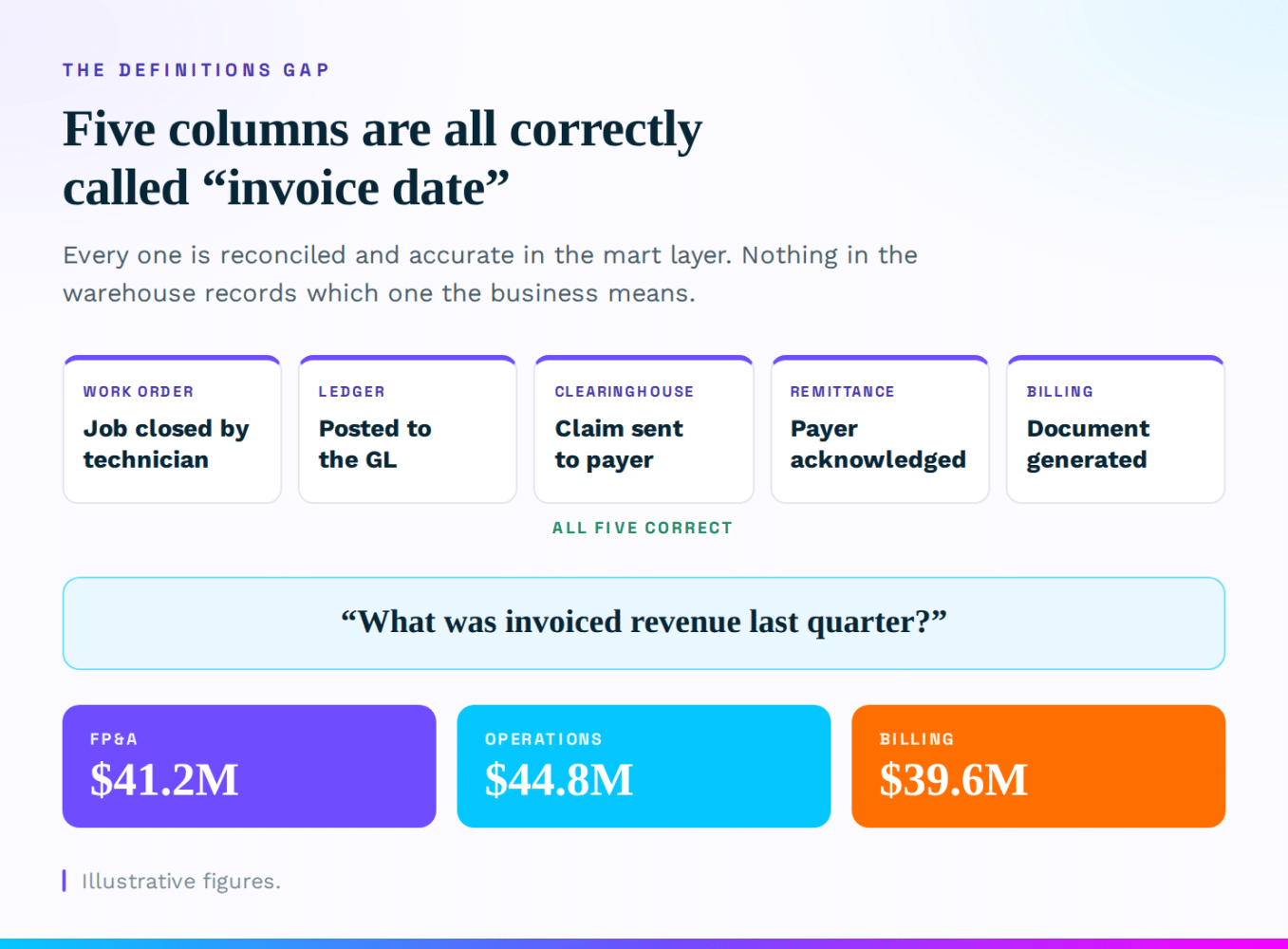
The problem is that nowhere in the warehouse is there a record of which column the business is referring to when someone references, “invoiced revenue”. An AI assistant will confidently return an answer, but not the version the CFO needed. Why? Because the information required to make that choice is not documented. And, that problem is not unique to “invoice date”; every term in your operating plan has the same level of ambiguity.
For example, what qualifies as an active customer depends on whether you mean contracted, billed, or served in the last ninety days. Whether a service line corresponds to what the ERP calls a ‘division’, or to what branch managers schedule against is a question that no column answers.
Cleaning and producing higher quality data will never close this gap.
Why documentation won’t solve the need for an ontology
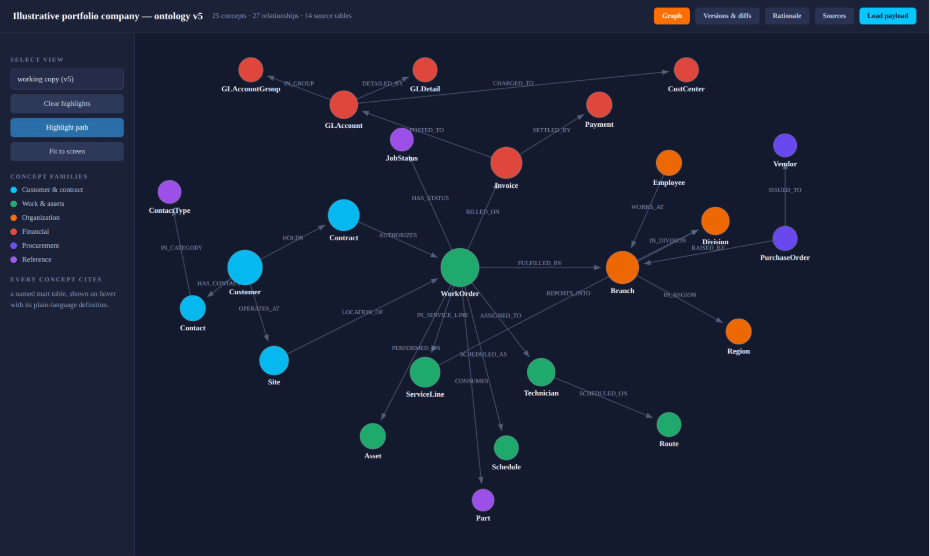
The formal name for this missing layer is an ‘ontology’. An ontology is an explicit statement of the concepts a business operates on, the properties they carry, and the relationships that connect them. For example, a customer holds the contract; the contract authorizes the work order; the work order posts to the GL account. When documented properly, this sequence tells a system what your data rows represent instead of leaving this to interpretation from schema names.
The first mistake is treating an ontology as a static document. We suspect that a large percentage of ontology work never makes it past a diagram. A written definition only works if the system answering your questions reads it, which means the model must be connected to your live systems. Without this connection, the system works out its own path, and every step is another chance to take a wrong turn. While loading the model inside your organization is necessary, that step alone is not sufficient: it must be rebuilt when new mart tables arrive, which happens whenever a business adds a new system, site, or entity.
Lastly, someone must own the question of which version is current. The process is iterative by design.
The second mistake is building the ontology on the wrong layer. An ontology inherits the character of whatever layer it gets built on. For example, our early drafts pulled from everything available – source tables and transform layers included – so the resulting models included some artifacts that carried little meaning for an operator.
Our domain experts pushed back on this, and the rule we adopted in response continues to hold:
- The model builds only on the mart layer, and every concept and relationship inside cites a named mart table
- If something is not inside a mart, it’s not added to the model
That constraint improved the output significantly because what belongs inside a mart is a question that the business has already debated (and resolved).
Judgment is the expensive part
For an ontology to work, a human-in-the-loop must decide which tables become concepts, and which become properties of a concept that already exist. Someone must also decide how deep the hierarchy runs, since an organization can be modeled as: a branch and a region; a branch, district, and a division. Both options are defensible, so a human must decide whether a customer operating under two acquired brands is one customer with two relationships, or two customers that happen to have the same parent company. The two models report different retention rates despite having the same data, and nothing in the data conveys which version is accurate.
Here’s an example of how this can go wrong.
An early ontology draft for one of our clients promoted “Status” to a business concept, a node holding open, closed, and cancelled, with every work order linking to it. On a diagram it looks tidy. Our team removed it, because “closed” is not a thing the business interacts with; it is a property of a work order. Modeled as a concept, it becomes one of the most connected nodes in the graph while carrying no meaning of its own, and the model gets denser while saying less about how the business runs.
While “Status” has a somewhat obvious answer, the same question gets harder when it turns to whether a service visit ends when the technician leaves the site or when the invoice clears, or whether cost of goods decomposes in three ways or four. None of those answers are retrievable from the data. There is no query that returns the correct one because the answer depends on how the business is run and what management needs to measure, which is why the work requires someone who can read a database schema and hold their own with a head of operations.
Those two skills rarely live inside the same person.
What our team automated is everything around the judgment component of an ontology, so that a decision is made once, then holds across every subsequent run.
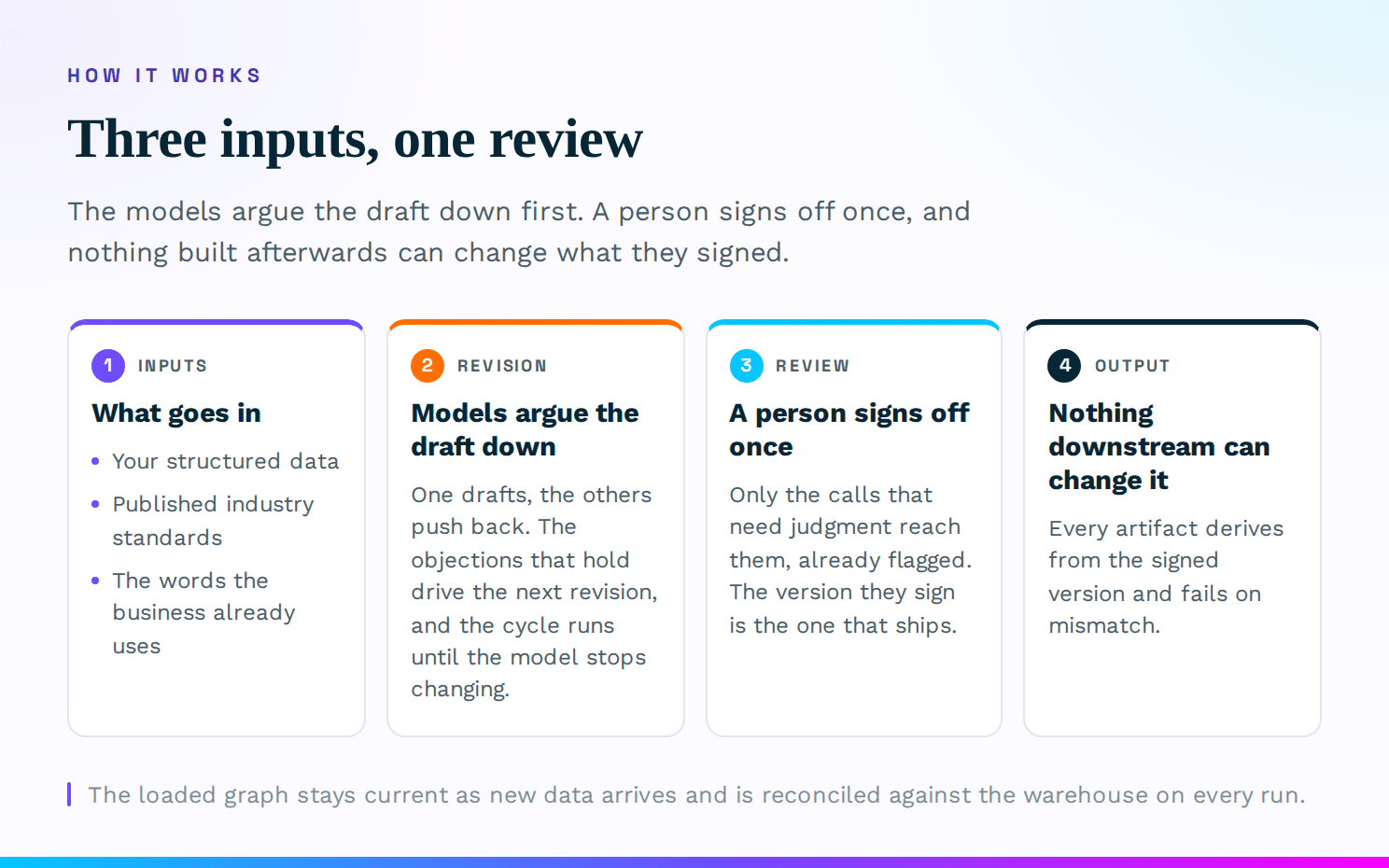
How building an ontology works
The pipeline takes three inputs:
- your structured data
- published standards for how your industry defines and reports its numbers
- business terms, pulled from a range of unstructured data
Everything drawn from context is verified against the warehouse before it enters the record, so the model reflects what the data can support without over-customizing specific requests.
From those inputs, it produces a draft model, and the draft is where the real work begins. The revision cycles run between models: one drafts, others challenge it, and the objections that hold drive the next revision. Only after the draft has been through multiple rounds, and the models have stopped finding things to fix, does it come back to a human with the points flagged as needing judgment.
Your expert reviews once, instead of supervising every iteration.
What comes out on the other side is bound to that approval. Every downstream artifact derives from the signed version and fails on mismatch, so what your expert approved is what ships. The loaded graph stays current as new data arrives, and is continuously reconciled against the warehouse, ensuring the model and the source of truth can’t drift apart.
Is the data explainable and defensible?
Consider this. An FP&A lead hands the CFO a site-level margin figure, which then goes into a lender package and in front of an investment committee. Someone asks how margin is defined, and the only answer available is that AI produced it from the warehouse.
That answer puts every other number in the package under a new level of scrutiny.
The market is walking into this gap with reasonable awareness of it. Grant Thornton’s 2026 AI Impact Survey found that three out of four boards have approved major AI investments, while fewer than 50% have set governance expectations for those systems. The same survey found that, among companies still piloting AI, only 7% believe they could pass an AI governance audit (vs. 74% of companies with AI fully embedded in their operations).
What to ask before you sign off on a number
Will it produce the same data again? Ask for the model to be regenerated from the same inputs and compared against the current version. If the two differ, there is nothing to approve.
Which table does this concept come from? Not what the concept means, but from where it originates. If no one can provide the source of origin, treat the number as unknown.
What changed since the last version, and who approved it? A model without version history or rationale behind every change technically has no owner.
What happened when the systems disagreed? Ask specifically to see the conflicts. They are usually the most informative material because each discrepancy marks where the business made changes.
The Value Orchestration Approach
Our reviewers are operators
When we say a domain expert approves the model, we mean someone who has run a business like yours is deciding whether a work order belongs under a branch or under a route. Our reviewers are operators who have carried a P&L in field services, financial, healthcare, and industrial services. Most ontology work has no one in that chair. Instead, there are highly technical people who can read the tables but can’t say whether the model matches how the business is actually run.
The value is establishing where your business differs from business operating model patterns
And that judgment feeds something larger. Every engagement deepens a reference model that we maintain, organized around business operating models rather than industries. The distinction matters most in how the money is modeled. A chain of ten dental clinics and a chain of ten burger restaurants sell nothing alike, but they generate EBITDA the same way. Revenue is earned inside four walls, site-level costs sit against it, and shared procurement and overhead are allocated from above. Both face the same recurring question of what rolls up to a site and what belongs to the group. That financial skeleton is the part of the model that carries over: how revenue is recognized, how costs attach to a location, where margin is measured. An ontology almost never transfers entirely, and it does not need to.
What accrues is a generalized understanding of how the operating model works. The value is establishing where your business differs from the operating model pattern, which is the part that’s unique to your business.
For a sponsor holding several companies with similar operating models, this work compounds on two dimensions:
- First, each company reaches a defensible number faster, because the operating model’s recurring structure arrives immediately instead of being restarted from scratch. And, because the portfolio companies share the same underlying definitions, margin means the same thing in every board pack.
- Second, a number from one portco can sit next to a number from another portco in a lender package without a footnote explaining that they were measured differently. When the exit process starts, that consistency is the difference between data that answers questions vs data that generates them.
The model is not our learning curve; it’s a portfolio asset, and every acquisition with a similar operating model shortens the path from close to a number the board can trust. Simply linking your data to AI doesn’t give your business the answers it needs because it still lacks the framework and the context to produce real value, which is where an ontology comes in.
That is what we mean by “speed to value”.

Gert De Geyter Ph.D. is a Staff AI/ML Engineer at Teragonia , where he is a core contributor on the ontology and knowledge graph features in the firm’s AstradisTM platform. He holds a PhD in astrophysics from Ghent University, teaches in Columbia University’s Applied Analytics program, and hosted a DataCamp webinar on combining LLMs with knowledge graphs.

Tom Thayyil Thomas works on AI/ML Engineering for Teragonia. He holds a BS in Computer Science from Georgia Institute of Technology with concentrations in artificial intelligence and theoretical computer science and a minor in the microeconomics of strategic analysis and is pursuing an MS in Computer Science at Georgia Tech specializing in AI.
Foundational Tech Infrastructure
Our core analytics and AI platform drives informed decision-making with enhanced clarity and focus, and rapidly unlocks enterprise value
Core Features:

Connect All Your Data Sources
Integrate data from multiple source systems effortlessly
Critical for breaking down silos and creating a unified view

One Trusted Data Source
A secure, centralized cloud hub for all your data insights
Foundational for reliable decision-making and enterprise-wide alignment

Interactive Dashboards
Visualize complex data through easy-to-understand dashboards
Empowers leaders with actionable insights

Enriched Data Flow, Fully Automated
Reverse ETL capabilities enriches your data and ensures your data flows exactly where it is needed for function teams to act on
Enables real-time, action-oriented data flow

Additional AI capabilities are actively in development

Scott Briggs
BS International Business | American University of Paris
BS Computer Science | American University of Paris
Seasoned DevOps and infrastructure engineer with expertise in AWS, Kubernetes, and Terraform; led cloud migrations and scalable infrastructure projects at Sfara, FanDuel, and Kickstarter.
With over 15 years of experience in small and medium-sized startups, Scott is a seasoned expert in designing, optimizing, and maintaining robust, scalable, and secure infrastructure. He specializes in automation and embedding security from the ground up, consistently delivering reliable systems tailored to meet dynamic business requirements.
Prior to joining Teragonia, Scott made a significant impact at Sfara, where he built the company’s entire infrastructure from scratch. He engineered systems capable of supporting hundreds of thousands of users with seamless scalability, implemented automated development pipelines, and introduced observability tools to monitor and manage resources effectively. Additionally, Scott led the infrastructure team in achieving ISO27001 security certification, ensuring security was integrated into every aspect of the system and transforming it into a critical asset for business-to-business operations.
Beyond his technical expertise, Scott has a proven track record of managing and mentoring high-performing teams. As a Senior DevOps Engineer at FanDuel, he gained invaluable experience in scaling infrastructure and optimizing resources to support millions of daily users, aligning technological capabilities with organizational goals.

Jack Amedio
Master’s in Human Resources | University of Illinois
Bachelor’s in Management | Loyola University
Former Financial and Operations Manager at Houlihan Lokey, Golin Harris, and MSL Group.
Jack is a highly driven, cross functional professional with extensive experience in operations and administration.
Prior to joining Teragonia, Jack held financial and facilities management roles for Houlihan Lokey, MSL Group/Publicis, and Golin Harris in which managed and created processes and trainings for multiple functional areas ensuring operational and administrative procedures were well planned, efficient, cost-effective, and aligned with business objectives while ensuring initiatives, internal events as well as client events propelled employee and client engagement.
Jack holds undergraduate degrees from University of Illinois and Loyola University Chicago and has completed graduate certificates in Business Administration, Strategic Human Resources, and Operations at Cornell, CUNY-Buffalo, and University of Illinois and is in the process of completing a Master’s in Human Resources at Loyola University Chicago’s Quinlan School of Business.

Mason Taylor
MS Analytics | Georgia Institute of Technology
BS Management Information Systems | Oklahoma State University
Former analytics engineer at Cyderes and ConocoPhillips with a Master’s in Analytics from Georgia Institute of Technology and a Bachelor’s in Management Information Systems from Oklahoma State University
Mason is an Analytics Engineer with deep experience in data analytics, business intelligence, machine learning, and cybersecurity. He brings a proven track record of leading analytics engagements spanning architecture, insights, visualizations, and delivery.
Before joining Teragonia, Mason was a Senior Analytics Engineer at Cybersecurity MSSP CYDERES where he built a scalable, standardized, and secure analytics architecture for over 300 clients across many industries and consulted with them to deliver insights through bespoke data driven solutions. In addition, he managed the data delivery of the insight platform leveraged by the Security Operations Center to respond to incidents in a timely and effective manner.
Prior to joining CYDERES, Mason worked in ConocoPhillips’ Analytics and Innovation Center of Excellence holding varied roles within the Data Analytics organization from Data Engineering, to Business Intelligence, and Data Science. He delivered robust data solutions in all operating units for various functions including Engineering and Production, Finance, IT, and more. Including projects to standardize cost and production data across operating units.
Mason started his career at The Williams Companies in cybersecurity and transitioned to cybersecurity at ConocoPhillips where he found his passion for Data Analytics through SIEM management, detection engineering, and threat intelligence.

Grace Sun
Bachelor’s in Finance & Accounting | Georgetown University
Former analytics engineer at Houlihan Lokey and financial analytics at JP Morgan Chase with a Bachelor’s in Finance & Accounting at Georgetown University
Grace is a seasoned analytics engineer with specialized expertise in crafting and implementing analytics solutions that drive agile, informed executive decisions in M&A and value creation for private equity-backed companies.
Before joining Teragonia, Grace was a part of the data science and business analytics team at Houlihan Lokey. She has excelled in harmonizing, enriching, and analyzing data from diverse sources, providing key insights that enabled private equity investors and portfolio company executives to make rapid, data-driven decisions across the investment lifecycle. She has developed novel analytics solutions, including deal sourcing and evaluation tools for platform investments that employ a buy-and-build or de novo growth strategy, as well as post-close value creation and KPI reporting tools for operators and management teams.
Grace has also worked at JPMorgan Chase & Co. in the Global Finance and Business Management rotational program, where she built analytics solutions to evaluate banker attrition and KPI reporting within the Global Private Bank.