












Value Orchestration: Activating AI to Drive EBITDA
An operator’s playbook for turning predictive insights into decisions that move margin.
By Sai Mali Ananthanarayanan, PhD, Co-Founder & Chief AI Officer, Teragonia and Chukwudera Mojekwu, Senior Data Scientist, Teragonia
Across PE-backed mid-market companies, the biggest barrier to capturing AI’s promise isn’t modeling—it’s orchestration. Insights exist, but they arrive too late, live in silos, and rarely translate into coordinated action. Value Orchestration is the discipline that links data to margin to execution so operators can act at the right moment for impact.
Teragonia’s Astradis™ platform enables this framework end-to-end: a reconciled data foundation, predictive ML to see risk and opportunity, our proprietary FibronAI to prioritize and explain the next best move, and guardrailed execution that pushes actions into ERP and CRM—measured against EBITDA. Running this framework in 90-day cycles compounds value quickly and repeatably across a portfolio.
Here’s what that looks like in a retail industry scenario where short-life SKUs make or break margin.
Context: A $700M retailer manages thousands of shortlife SKUs across multiple warehouses. The business lives and dies by how well it anticipates demand swings: get it wrong, and the costs show up in lost sales from stockouts, waste costs from overstock, and margin leakage from missed procurement windows.
Before Astradis™ Implementation
- The demand planner spent 20+ hours each week pulling invoice files into Excel and manually tuning new SKUs with little history.
- Errors crept in, stockouts frustrated customers, and disconnected systems created blind spots across sales, procurement, and operations.
- No one could quantify how these misses translated into lost revenue or wasted margin, and EBITDA leakage went unmeasured.
After Value Orchestration with Astradis™
- A cross-functional data foundation unifies sales, returns, promotions, and warehouse data into a reconciled, auditable demand signal.
- Predictive ML, orchestrated through FibronAI, forecasts SKU-level demand with promotion effects and cold-start items included.
- AI activation surfaces where to size up or down, explains the rationale in business terms, and auto-populates purchase and transfer orders with guardrails.
- Planning time drops from ~20 hours to under 4, forecast accuracy improves visibly, waste from excess stock declines, stockouts fall, and procurement moves are better timed—producing measurable EBITDA lift.
Together, these gains compounded into a multi-point EBITDA improvement within a single quarter. That is value orchestration in action.
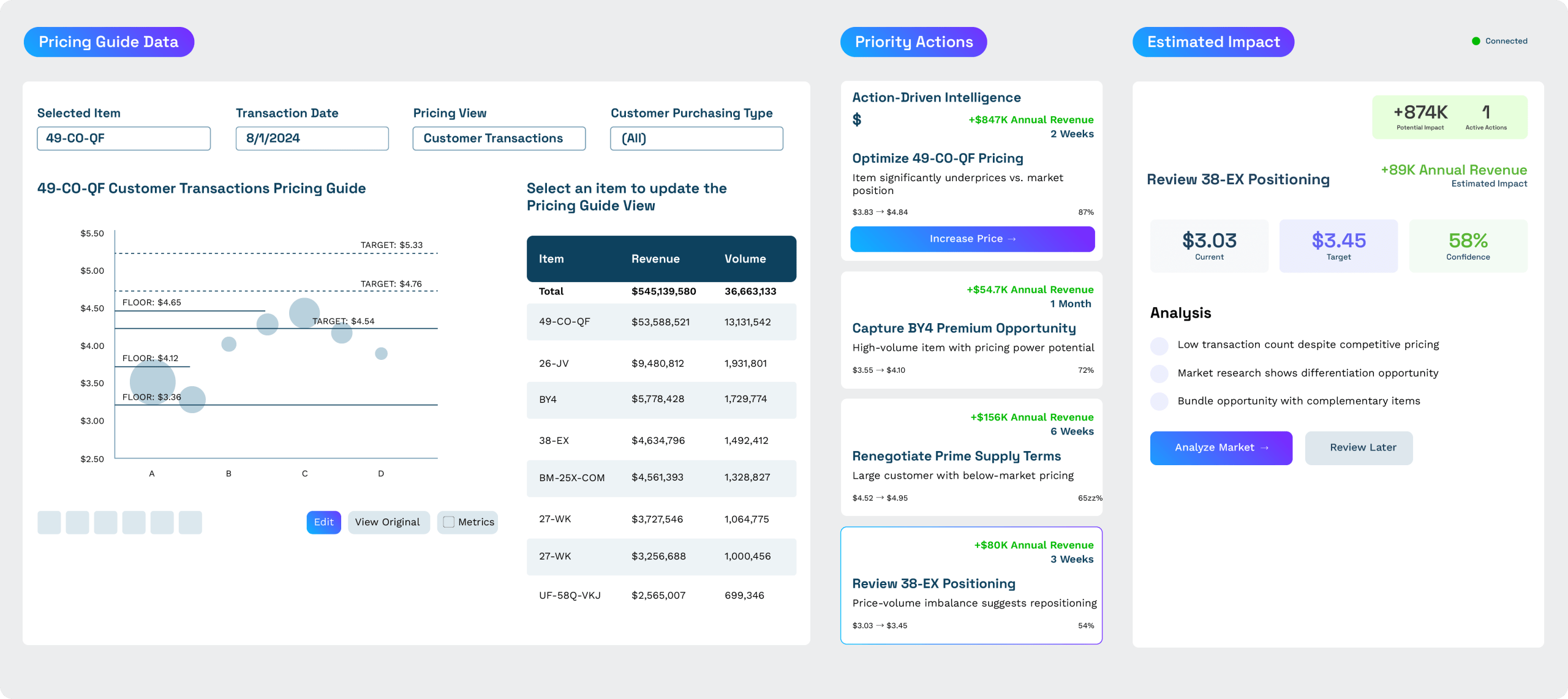
Value Orchestration cycles often run on a 90-day cadence—the same rhythm used by PE operating teams to measure performance and progress. Within that window, Astradis™ activates four to six focused value moves tied directly to EBITDA. These moves are measurable, repeatable, and portfolio-scalable, allowing PE sponsors to see value realization on a predictable schedule instead of waiting for annual planning cycles.
Most mid-market portcos are burdened with a familiar pattern: multiple ERPs and CRMs from acquisitions, spreadsheets doing the heavy lifting, and insights that arrive long after decisions are made. The result is fragmented, slow, and inconsistent decisions at the moments that determine performance—buying, stocking, pricing, and staffing. The impact shows up fast in the P&L as lost sales, excess inventory, and missed procurement windows that erode margin.
Three issues keep teams stuck:
- Siloed context — critical data like sales, inventory, and supplier terms live in different systems.
- Forecasts without guardrails — models predict but aren’t connected to approvals or policies that make them safe to act on.
- Change fatigue — operators resist tools that add work or bypass the controls they rely on.
Astradis™ closes this orchestration gap by reconciling context, embedding guardrails, and removing friction. Data becomes unified, actions become safe, and execution becomes fast—so every decision can move the P&L instead of just describing it.

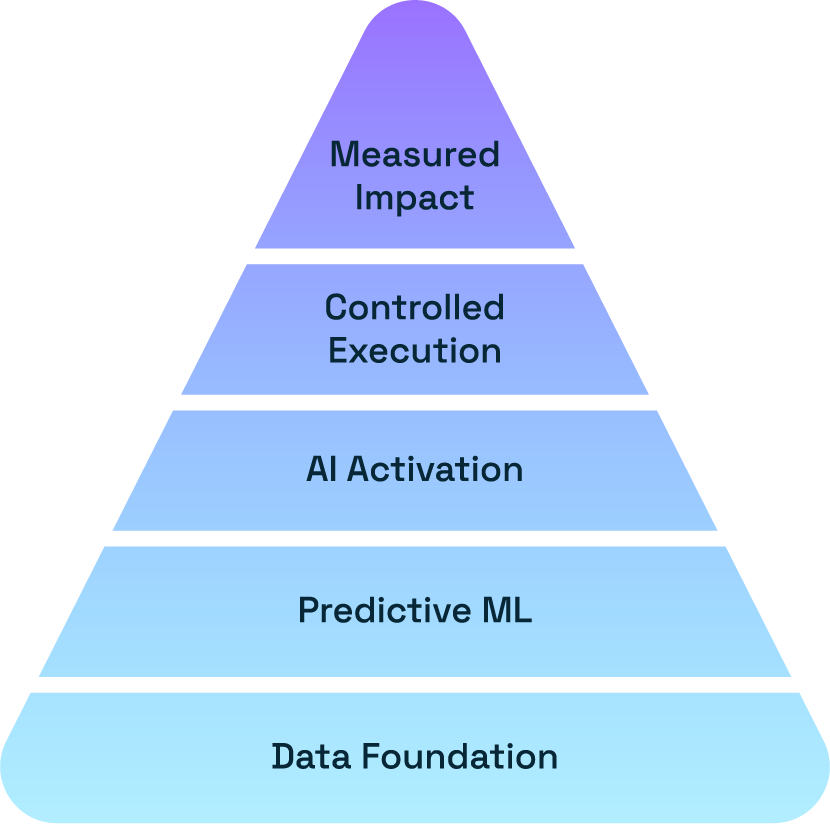
Every Teragonia deployment follows the same five-stage model that converts predictive insight into measurable EBITDA impact:
- Data foundation – Establish a reconciled, auditable source of truth that aligns financial and operational definitions. This includes unified data products such as inventory ledger, demand history, supplier terms, and promotion calendar. This foundation eliminates reconciliation cycles and exposes the real cost and margin levers hidden in operational data—creating a direct line of sight to EBITDA.
- Predictive Machine Learning – Forecast demand, lead times, and promotion effects at the right granularity (SKU × location × customer where relevant), with segment-level accuracy tracking. Predictive ML provides foresight—revealing where performance is trending and where value is at risk.
- AI activation – Powered by FibronAI, this layer turns foresight into action. It prioritizes the highest-impact moves, explains recommendations in business terms, and routes approved actions back into ERP and CRM systems with guardrails in place. In short, ML forecasts; AI activates.
- Guardrailed execution – Translate company policies—budget caps, service targets, working capital limits—into automated checks and approvals. Approved actions flow directly into ERP and CRM systems so work happens where teams already operate. Embedding guardrails in ERP and CRM ensures every move protects margin and working capital while maintaining compliance.
- Measured impact – Quantify every cycle’s effect on margin, inventory turns, waste, and working capital, rolling up to EBITDA improvement and value creation at the portfolio level. Each 90-day cycle reports verified improvements in COGS, waste, and inventory turns—rolling up to measurable EBITDA lift across the portfolio.
This isn’t a management fad—it’s the operating system for modern private equity:
- Always-on visibility into margin drivers.
- Real-time accountability across teams.
- Embedded AI that learns from every cycle of execution.
- Direct linkage between data investments and EBITDA outcomes.
When every decision compounds in the same direction, the traditional notion of “value creation plan” gives way to value creation flow.
“The firms that adopt Value Orchestration early are building a different kind of operating muscle—one that never stops learning, aligning, and acting.”
How We Implement It (method first, tool second):
- Ingest and model. Bring ERP/CRM/WMS data into a central hub and align it to the shared business view. Publish the data products above with lineage.
- Decide with guardrails. Translate policies into software: service targets, budget caps, shelflife rules, working capital limits; define auto-approval thresholds.
- AI to focus, act, explain. Present a ranked queue of actions with quantities, confidence ranges, and clear rationales; capture override reasons for learning.
- Activate where people work. Push approved recommendations back into ERP/CRM so buyers, managers, and planners move seamlessly from insight to action.
- Measure and close the loop. Track value creation through COGS savings, sales recapture, reduced waste, improved inventory turns, and time savings, reviewed consistently in a routine cadence.
Astradis™ implements this orchestration model in PE-backed environments, linking the data foundation, predictive ML, and AI activation layer so that every forecast flows through to a controlled, measurable decision that drives value creation within the investment horizon.
For PE-backed operators, the goal isn’t more predictions—it’s faster, safer, and more consistent decisions that lift EBITDA within each 90-day window. Predictive ML provides foresight; FibronAI activation turns that foresight into prioritized, explainable actions. Guardrails ensure those actions stay within policy, and the results are fully tracked and visible via the Astradis™ platform for clear attribution. Across a portfolio, this model compounds quarter after quarter—creating a durable, repeatable advantage that accelerates value creation at industry scale.

An accomplished applied mathematician, Mali specializes in machine learning, statistics, and optimization. With a PhD from Columbia University, his career highlights prior to joining Teragonia include optimizing portfolio strategies for Barclays, developing large-scale airline disruption recovery algorithms for GE Research, and improving elevator queue efficiency in NYC’s largest government office building.

Dera is a data scientist who leads applied machine learning initiatives that turn complex data challenges into practical products for decision-making that drive operational improvement. Before joining Teragonia, he developed advanced machine learning solutions and drove AI strategy at Raytheon Technologies, and contributed to the design of avionics systems for business jets.
Foundational Tech Infrastructure
Our core analytics and AI platform drives informed decision-making with enhanced clarity and focus, and rapidly unlocks enterprise value
Core Features:

Connect All Your Data Sources
Integrate data from multiple source systems effortlessly
Critical for breaking down silos and creating a unified view

One Trusted Data Source
A secure, centralized cloud hub for all your data insights
Foundational for reliable decision-making and enterprise-wide alignment

Interactive Dashboards
Visualize complex data through easy-to-understand dashboards
Empowers leaders with actionable insights

Enriched Data Flow, Fully Automated
Reverse ETL capabilities enriches your data and ensures your data flows exactly where it is needed for function teams to act on
Enables real-time, action-oriented data flow

Additional AI capabilities are actively in development

Scott Briggs
BS International Business | American University of Paris
BS Computer Science | American University of Paris
Seasoned DevOps and infrastructure engineer with expertise in AWS, Kubernetes, and Terraform; led cloud migrations and scalable infrastructure projects at Sfara, FanDuel, and Kickstarter.
With over 15 years of experience in small and medium-sized startups, Scott is a seasoned expert in designing, optimizing, and maintaining robust, scalable, and secure infrastructure. He specializes in automation and embedding security from the ground up, consistently delivering reliable systems tailored to meet dynamic business requirements.
Prior to joining Teragonia, Scott made a significant impact at Sfara, where he built the company’s entire infrastructure from scratch. He engineered systems capable of supporting hundreds of thousands of users with seamless scalability, implemented automated development pipelines, and introduced observability tools to monitor and manage resources effectively. Additionally, Scott led the infrastructure team in achieving ISO27001 security certification, ensuring security was integrated into every aspect of the system and transforming it into a critical asset for business-to-business operations.
Beyond his technical expertise, Scott has a proven track record of managing and mentoring high-performing teams. As a Senior DevOps Engineer at FanDuel, he gained invaluable experience in scaling infrastructure and optimizing resources to support millions of daily users, aligning technological capabilities with organizational goals.

Jack Amedio
Master’s in Human Resources | University of Illinois
Bachelor’s in Management | Loyola University
Former Financial and Operations Manager at Houlihan Lokey, Golin Harris, and MSL Group.
Jack is a highly driven, cross functional professional with extensive experience in operations and administration.
Prior to joining Teragonia, Jack held financial and facilities management roles for Houlihan Lokey, MSL Group/Publicis, and Golin Harris in which managed and created processes and trainings for multiple functional areas ensuring operational and administrative procedures were well planned, efficient, cost-effective, and aligned with business objectives while ensuring initiatives, internal events as well as client events propelled employee and client engagement.
Jack holds undergraduate degrees from University of Illinois and Loyola University Chicago and has completed graduate certificates in Business Administration, Strategic Human Resources, and Operations at Cornell, CUNY-Buffalo, and University of Illinois and is in the process of completing a Master’s in Human Resources at Loyola University Chicago’s Quinlan School of Business.

Mason Taylor
MS Analytics | Georgia Institute of Technology
BS Management Information Systems | Oklahoma State University
Former analytics engineer at Cyderes and ConocoPhillips with a Master’s in Analytics from Georgia Institute of Technology and a Bachelor’s in Management Information Systems from Oklahoma State University
Mason is an Analytics Engineer with deep experience in data analytics, business intelligence, machine learning, and cybersecurity. He brings a proven track record of leading analytics engagements spanning architecture, insights, visualizations, and delivery.
Before joining Teragonia, Mason was a Senior Analytics Engineer at Cybersecurity MSSP CYDERES where he built a scalable, standardized, and secure analytics architecture for over 300 clients across many industries and consulted with them to deliver insights through bespoke data driven solutions. In addition, he managed the data delivery of the insight platform leveraged by the Security Operations Center to respond to incidents in a timely and effective manner.
Prior to joining CYDERES, Mason worked in ConocoPhillips’ Analytics and Innovation Center of Excellence holding varied roles within the Data Analytics organization from Data Engineering, to Business Intelligence, and Data Science. He delivered robust data solutions in all operating units for various functions including Engineering and Production, Finance, IT, and more. Including projects to standardize cost and production data across operating units.
Mason started his career at The Williams Companies in cybersecurity and transitioned to cybersecurity at ConocoPhillips where he found his passion for Data Analytics through SIEM management, detection engineering, and threat intelligence.

Grace Sun
Bachelor’s in Finance & Accounting | Georgetown University
Former analytics engineer at Houlihan Lokey and financial analytics at JP Morgan Chase with a Bachelor’s in Finance & Accounting at Georgetown University
Grace is a seasoned analytics engineer with specialized expertise in crafting and implementing analytics solutions that drive agile, informed executive decisions in M&A and value creation for private equity-backed companies.
Before joining Teragonia, Grace was a part of the data science and business analytics team at Houlihan Lokey. She has excelled in harmonizing, enriching, and analyzing data from diverse sources, providing key insights that enabled private equity investors and portfolio company executives to make rapid, data-driven decisions across the investment lifecycle. She has developed novel analytics solutions, including deal sourcing and evaluation tools for platform investments that employ a buy-and-build or de novo growth strategy, as well as post-close value creation and KPI reporting tools for operators and management teams.
Grace has also worked at JPMorgan Chase & Co. in the Global Finance and Business Management rotational program, where she built analytics solutions to evaluate banker attrition and KPI reporting within the Global Private Bank.