By Sai Mali A., Ph.D., Chief AI Officer and Co-Founder, Teragonia
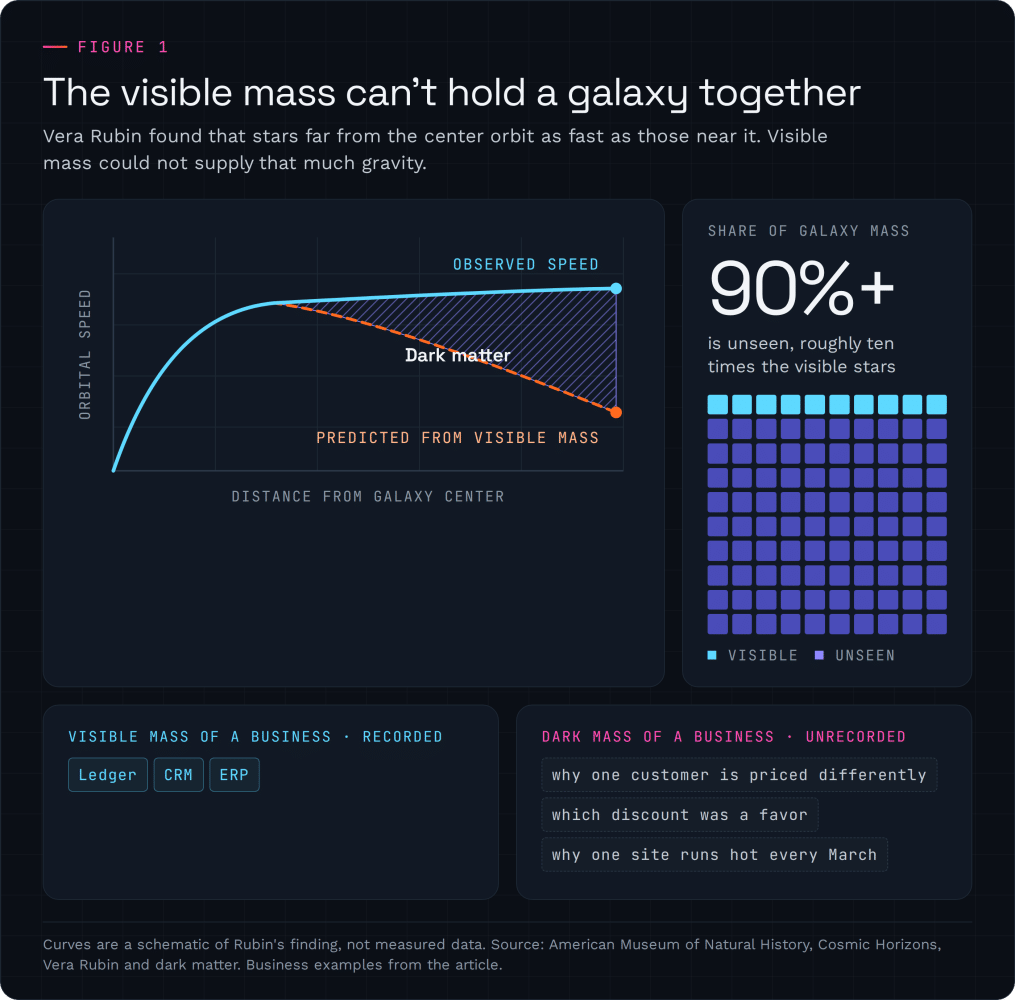
The ledger, CRM and ERP record the visible mass of a business, yet what holds it together is the context and knowledge that is rarely ever written down. Nuances like why one customer is priced differently, which discount was discounted as a favor or for a strategic reason, or why one site runs hot every March; this information lives inside the memories of a few key employees with no shared definition of what the numbers mean across teams.
Astronomers did not need to visibly see dark matter to take it seriously. They treated the motion as evidence, measured its effects carefully, and mapped where the mass sat by how it bent the light of the galaxies behind it.
A business gives off similar evidence.
For example, when a contract is signed, different people enter it into disparate systems that rarely speak to one another. A price in one table might look like an error, yet someone on the team set it that way consciously; a report that no one trusts is rebuilt in a spreadsheet every month, and only a few people in the business know why.
Most AI in-use today reads a visible record. A larger model can read these records even faster, and deliver the answers with more confidence (despite still being wrong), but they can’t provide a reason or context that was never recorded. As a result, the reason must be drawn out of the person who holds it, stored in a way that a machine can read, and verified before anyone can act meaningfully on it.
In a 2025 SHRM survey of US HR professionals, 83% said their organization documents company policies, while only 43% document client relationships and 32% document cultural norms. And, the people who hold the innerworkings of a business do not stay long. The Bureau of Labor Statistics reported that median tenure for US workers is 4.1 years (as of January 2026). Every time an employee leaves, a company loses a share of its own knowledge.
Private equity exacerbates this problem at three critical points.
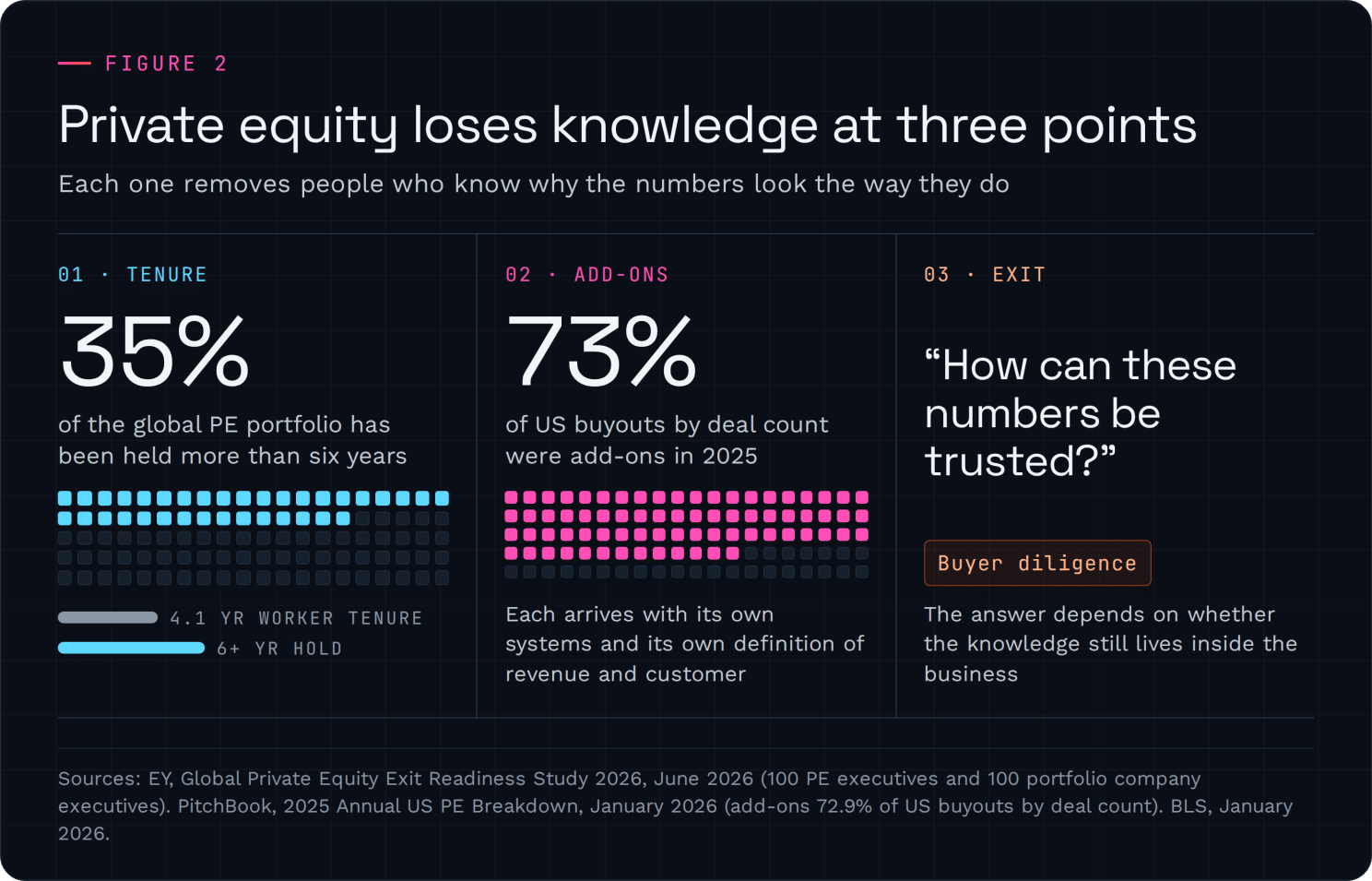
EY’s 2026 exit readiness study found that 35% of the global PE portfolio has been held for more than six years, well beyond the four-year median tenure of a US worker, so a longer hold outlasts many of the people who understand the innerworkings of the business.
Sponsors also buy add-ons, which PitchBook counts at 73% of US buyouts by deal count last year, each arriving with its own systems, definitions of revenue and customer, and the people inside those businesses who understand the nuances of why they differ.
At exit, a buyer asks how the numbers can be trusted, and the answer depends on whether that knowledge is still lives inside the business.
While Spending on AI continues to rise, its ROI and impact remain uneven.
As Dr. Kwesi Apponsah of our Astra Labs business unit wrote earlier this month, S&P Global Market Intelligence found that 42% of companies abandoned most of their AI initiatives before they reached production last year, up from 17% the prior year. In his article, Dr. Apponsah argues that these projects stall because no one defined the financial result they were meant to produce, and that organizations should put a price on every expected result before it funds any AI build.
Recent data is more encouraging, with a caveat. Boston Consulting Group’s Applied AI Index 2026 found that nearly half of companies now capture real value from AI (vs 5% from the same study year earlier).
Across these studies, obstacles leaders’ cite most frequently are data privacy, security, cost, and control.
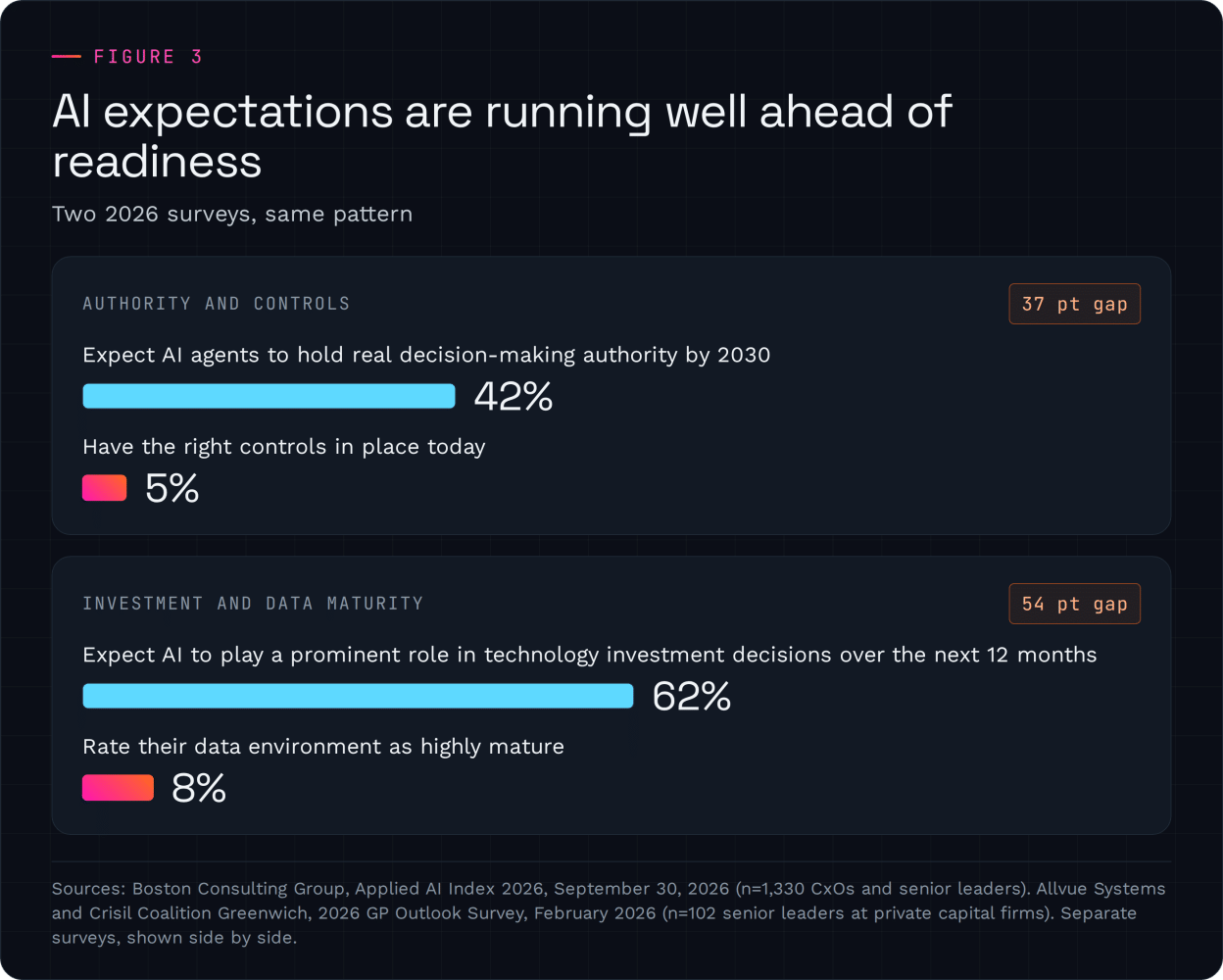
BCG specifically points to control as the underlying cause of deriving real value from AI investment: by 2030, 42% of companies expect to give AI agents real decision-making authority, yet just 5% have the right controls in place today to achieve these expectations.
In practice, control means knowing what a number means, who decided it, and why. A model that has not been given context on a company will still return answers on it confidently. Some tools add a confidence score, but a score can’t tell you whether AI used your definition of revenue, so a wrong response can still return a high score.
Spending on AI initiatives continues to rise.
For example, 62% of private capital leaders expect AI to play a prominent role in technology investment decisions over the next 12 months, yet only 8% rate their firms’ data environments as highly mature, according to Allvue Systems and Crisil Coalition Greenwich’s 2026 GP Outlook Survey. EY’s exit readiness study finds the same weakness at the point of sale: most GPs name building a reliable set of data and KPIs as the hardest part of preparing a finance function for sale.
Ultimately, a buyer will look for a distinction between AI activity and AI strategy, and without a governed data foundation, AI claims are hard to evidence. A buyer asking for that evidence is really asking what the company knows, and how they can demonstrate this knowledge.
Most sponsors expect a return from AI, yet few have built the data foundation that return depends on.
The larger consequence of that foundation is a shift in where a company’s memory lives. For centuries, the unit of corporate memory has lived with human beings. Over the next decade, this knowledge must evolve to live inside a system, or a governed record of what the business means, which decisions were made and why, and what changed, when. A dashboard is a snapshot, and most AI answers from the same snapshot with the confidence of live data. Instead, organizations require a living, breathing record that updates as the business changes, and keeps a note of who defined each term.
We call this knowledge the context layer. Companies that build it will run better on AI, and they will own what they know in a way that survives any individual’s departure, acquisition, and change of owner.
Those that fail to evolve will continue to spend valuable time and resources debating which number is accurate at the start of every meeting.
A physician client we work with started with their data. It moved to a single EMR, which was a useful first step. However, a single system still cannot define its own terms. What the team really needed was lineage, documentation, definitions, and a shared map of how the business fits together, and they needed it to scale across more than 200 providers. Our work helped them uncover 40 KPIs hidden inside the systems they already had (vs the 17 they had been reporting on).
The slow part is the people: the person a deal waits on, or the person who must be on every call because of what they know Departments carry similar challenges. A team that owns its own version of revenue must trust a system it does not control to hold this information. In our experience, this is harder than anything technical we do, and it is where most efforts stall.
That’s why our work starts with the people. Our Value Orchestration Engineers work alongside operators who have run a P&L and understand why a price is a certain price. Together, they ask the questions no query can answer and record every response. Credit keeps the status with the person who earned it, which is why people contribute, and the company retains the knowledge.
Of the eight third-party ontology products we reviewed, none of them document how a person’s knowledge gets into the model. That’s how we know our process is unique.
There are multiple ways to build a platform around a company’s knowledge.
In one approach, the platform is the only location where that knowledge can be understood. The logic sits in a proprietary layer, and the business depends on their vendor to operate it, and the vendor’s engineers remain on site with another workstream always ready to open. That model is sticky by design.
For a company with a hold period and an exit ahead, it’s a poor trade. A platform that only someone else can run is a dependency, and a buyer in diligence will price it as one.
We built Astradis differently. Every engagement ends with the company running more of the platform itself. The data sits in a warehouse that internal teams can query directly, the company owns its data and its definitions, and is not tied to any one AI model.
Our job is to leave the business more capable than we found it.
In the coming years, I expect investment committees to ask, “What does your company know, and who owns it?”
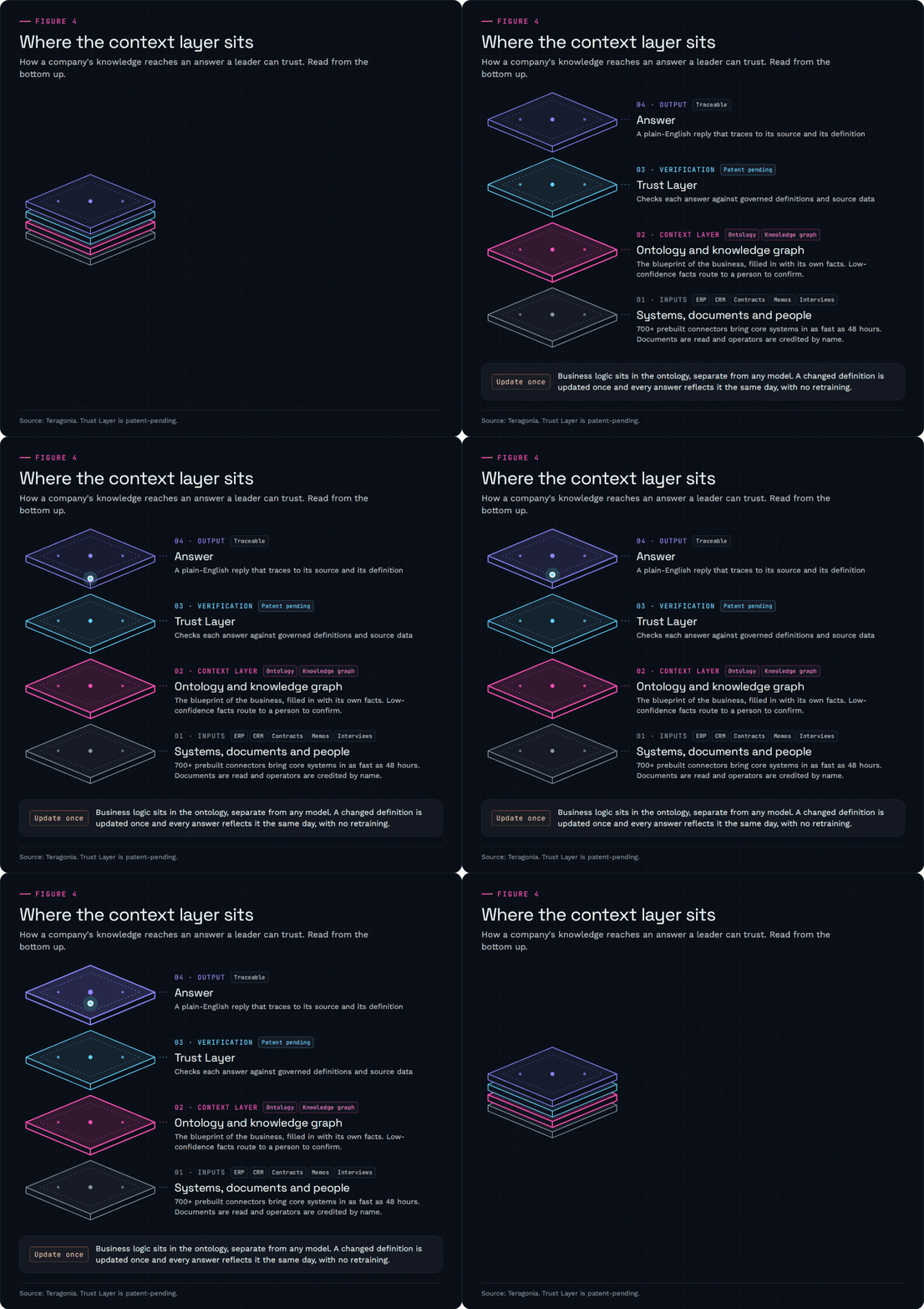
Astradis is the AI operating system for PE-backed companies. Core systems connect in as little as 48 hours through more than 700 prebuilt connectors, and our Data Modeling Autopilot (DMAAI) reads thousands of tables and infers how they join, writing the data model for our engineers to approve. DMAAI is the subject of four pending patent applications. A build that can takes up to 18 months with conventional methods is something we deliver in weeks. On top of that foundation sits the context layer that holds two critical components. The ontology is the blueprint of the business: what a customer, a contract or a site is, which relationships between them are valid, and how each metric is calculated. Companies in the same industry share most of that blueprint, so becomes more PE-native with every company that runs on it. The knowledge graph is the blueprint filled in with a company’s facts: these customers, on these contracts, served from these sites.
It is the map of the dark matter of the business that is often invisible.
The knowledge graph lets a leader ask a question that crosses the business, such as which customers up for renewal next quarter are served from the two highest-cost sites, and get it answered in one pass.
Much of what fills the graph has never lived inside a table. Astradis reads contracts, board memos and interview notes, extracts the facts inside, scores its confidence in each, and routes anything uncertain to a person to confirm. The human part of the process flows like this: an operator explains a price to a Value Orchestration Engineer, the explanation is linked into the graph with their name on it, and the Trust Layer checks every answer that later relies on it.
Because the business logic lives in the ontology, separate from any model, a changed definition is updated once, and every answer reflects it the same day, with no retraining.
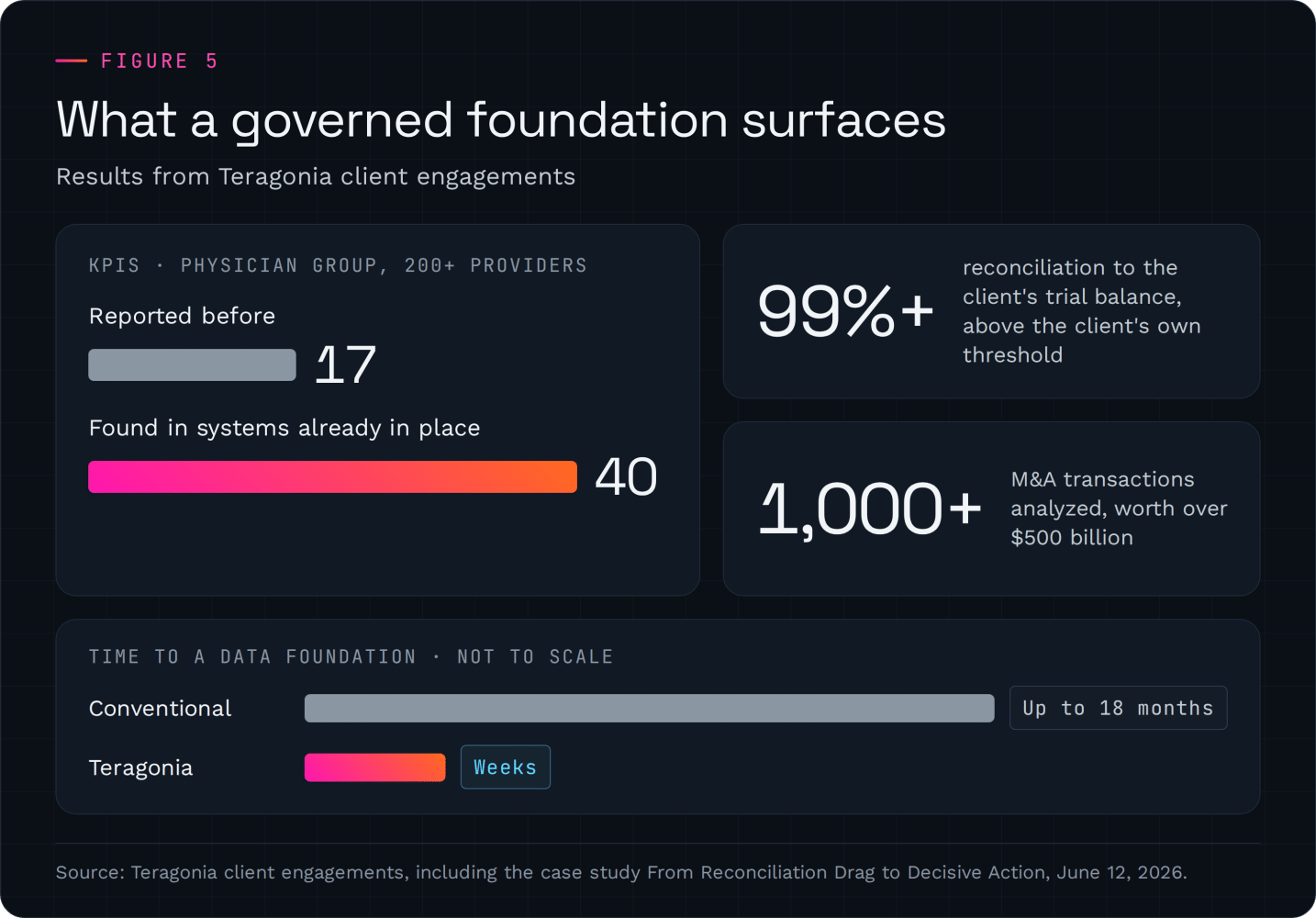
Earlier this week we announced the general availability of Talk2Astra, our conversational agent that lets a leader ask a question in plain English and receive an answer that traces back to its source and the definition behind it. Before any answer reaches the user, our patent-pending Trust Layer is designed to check it against the governed definitions and the source data, and flags or corrects what it cannot verify. In one engagement, results reconciled to the client’s trial balance at better than 99%, above the threshold the client had set for itself. Our team has prepared analytics for more than 1,000 M&A transactions worth over $500 billion, so we know which numbers get tested in diligence.
And, we continue to build:
Rubin’s finding changed astronomy by turning the invisible from a mystery into a quantity: once the unseen mass could be counted, it could be reasoned on. Companies have reached the same point. Models will continue to improve and become commoditized, so the real advantage is the knowledge that makes a model’s answer correct for your business.
Today, that knowledge sits in the dark matter of your business, where no system or model can see or reason on it. Tomorrow, it is the edge that no competitor can replicate.
Interested in learning how to work with us? Reach out at info@teragonia.com
About Teragonia
Teragonia turns private equity value creation playbooks into agents that drive the operating rhythm of mid-market businesses within commercial, operations and finance functions. Its team pairs operators who have spent their careers inside private equity, as investors, management teams, and M&A advisors, with AI and ML engineers who have built production systems at Morgan Stanley, GE Research, Barclays, Deloitte, and PwC.

Chief AI Officer and Co-Founder of Teragonia, responsible for AI and the direction of the Astradis platform. He holds a PhD in Industrial Engineering and Operations Research from Columbia University (Data Science Institute) and was previously a Senior Staff Data Scientist at Houlihan Lokey.
Sources:
Our core analytics and AI platform drives informed decision-making with enhanced clarity and focus, and rapidly unlocks enterprise value
Core Features:

Integrate data from multiple source systems effortlessly
Critical for breaking down silos and creating a unified view

A secure, centralized cloud hub for all your data insights
Foundational for reliable decision-making and enterprise-wide alignment

Visualize complex data through easy-to-understand dashboards
Empowers leaders with actionable insights

Reverse ETL capabilities enriches your data and ensures your data flows exactly where it is needed for function teams to act on
Enables real-time, action-oriented data flow


BS International Business | American University of Paris
BS Computer Science | American University of Paris
Seasoned DevOps and infrastructure engineer with expertise in AWS, Kubernetes, and Terraform; led cloud migrations and scalable infrastructure projects at Sfara, FanDuel, and Kickstarter.
With over 15 years of experience in small and medium-sized startups, Scott is a seasoned expert in designing, optimizing, and maintaining robust, scalable, and secure infrastructure. He specializes in automation and embedding security from the ground up, consistently delivering reliable systems tailored to meet dynamic business requirements.
Prior to joining Teragonia, Scott made a significant impact at Sfara, where he built the company’s entire infrastructure from scratch. He engineered systems capable of supporting hundreds of thousands of users with seamless scalability, implemented automated development pipelines, and introduced observability tools to monitor and manage resources effectively. Additionally, Scott led the infrastructure team in achieving ISO27001 security certification, ensuring security was integrated into every aspect of the system and transforming it into a critical asset for business-to-business operations.
Beyond his technical expertise, Scott has a proven track record of managing and mentoring high-performing teams. As a Senior DevOps Engineer at FanDuel, he gained invaluable experience in scaling infrastructure and optimizing resources to support millions of daily users, aligning technological capabilities with organizational goals.

Master’s in Human Resources | University of Illinois
Bachelor’s in Management | Loyola University
Former Financial and Operations Manager at Houlihan Lokey, Golin Harris, and MSL Group.
Jack is a highly driven, cross functional professional with extensive experience in operations and administration.
Prior to joining Teragonia, Jack held financial and facilities management roles for Houlihan Lokey, MSL Group/Publicis, and Golin Harris in which managed and created processes and trainings for multiple functional areas ensuring operational and administrative procedures were well planned, efficient, cost-effective, and aligned with business objectives while ensuring initiatives, internal events as well as client events propelled employee and client engagement.
Jack holds undergraduate degrees from University of Illinois and Loyola University Chicago and has completed graduate certificates in Business Administration, Strategic Human Resources, and Operations at Cornell, CUNY-Buffalo, and University of Illinois and is in the process of completing a Master’s in Human Resources at Loyola University Chicago’s Quinlan School of Business.

MS Analytics | Georgia Institute of Technology
BS Management Information Systems | Oklahoma State University
Former analytics engineer at Cyderes and ConocoPhillips with a Master’s in Analytics from Georgia Institute of Technology and a Bachelor’s in Management Information Systems from Oklahoma State University
Mason is an Analytics Engineer with deep experience in data analytics, business intelligence, machine learning, and cybersecurity. He brings a proven track record of leading analytics engagements spanning architecture, insights, visualizations, and delivery.
Before joining Teragonia, Mason was a Senior Analytics Engineer at Cybersecurity MSSP CYDERES where he built a scalable, standardized, and secure analytics architecture for over 300 clients across many industries and consulted with them to deliver insights through bespoke data driven solutions. In addition, he managed the data delivery of the insight platform leveraged by the Security Operations Center to respond to incidents in a timely and effective manner.
Prior to joining CYDERES, Mason worked in ConocoPhillips’ Analytics and Innovation Center of Excellence holding varied roles within the Data Analytics organization from Data Engineering, to Business Intelligence, and Data Science. He delivered robust data solutions in all operating units for various functions including Engineering and Production, Finance, IT, and more. Including projects to standardize cost and production data across operating units.
Mason started his career at The Williams Companies in cybersecurity and transitioned to cybersecurity at ConocoPhillips where he found his passion for Data Analytics through SIEM management, detection engineering, and threat intelligence.

Bachelor’s in Finance & Accounting | Georgetown University
Former analytics engineer at Houlihan Lokey and financial analytics at JP Morgan Chase with a Bachelor’s in Finance & Accounting at Georgetown University
Grace is a seasoned analytics engineer with specialized expertise in crafting and implementing analytics solutions that drive agile, informed executive decisions in M&A and value creation for private equity-backed companies.
Before joining Teragonia, Grace was a part of the data science and business analytics team at Houlihan Lokey. She has excelled in harmonizing, enriching, and analyzing data from diverse sources, providing key insights that enabled private equity investors and portfolio company executives to make rapid, data-driven decisions across the investment lifecycle. She has developed novel analytics solutions, including deal sourcing and evaluation tools for platform investments that employ a buy-and-build or de novo growth strategy, as well as post-close value creation and KPI reporting tools for operators and management teams.
Grace has also worked at JPMorgan Chase & Co. in the Global Finance and Business Management rotational program, where she built analytics solutions to evaluate banker attrition and KPI reporting within the Global Private Bank.