By Sebastien Roy, Ph.D. and Gert De Geyter, Ph.D., AI/ML Engineering, Teragonia
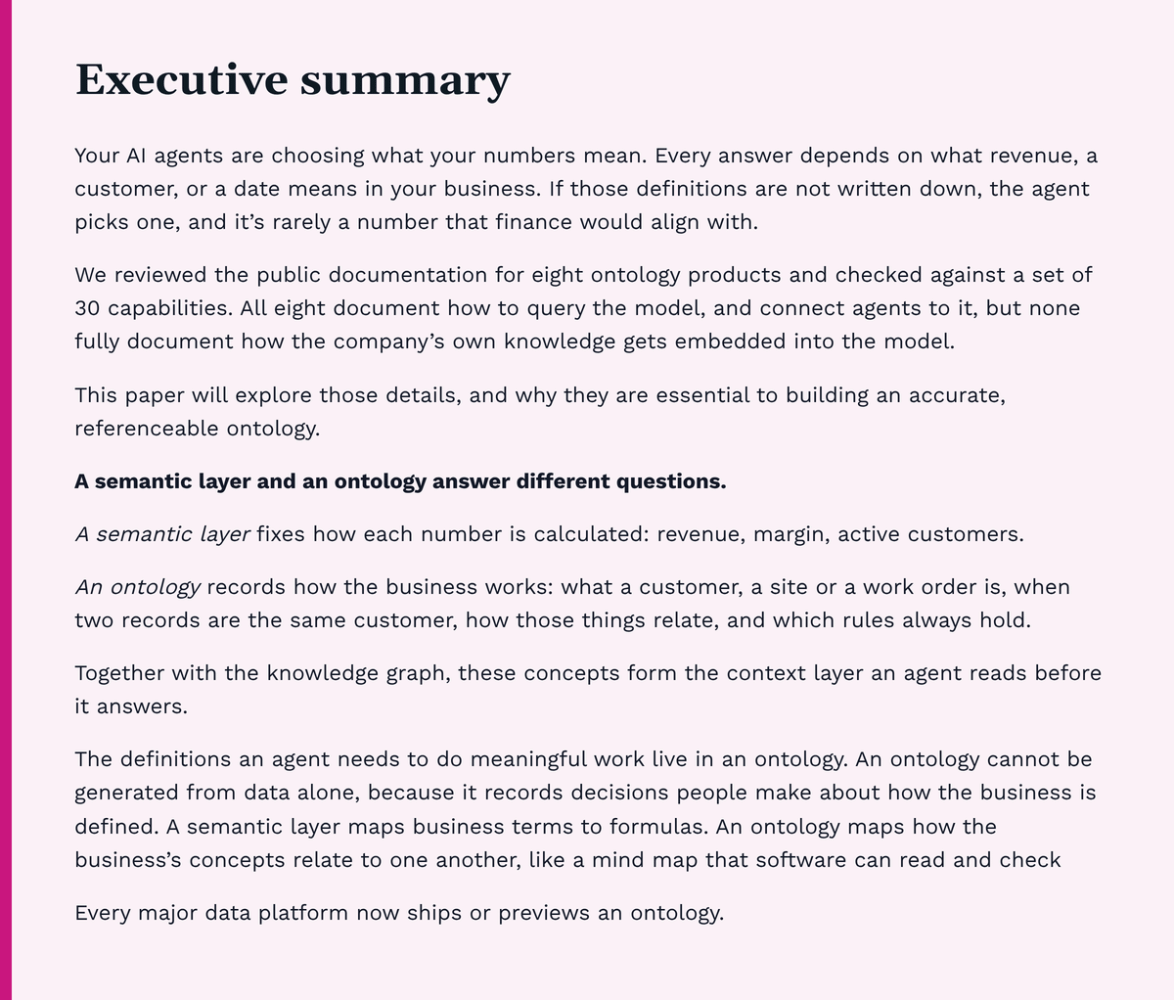
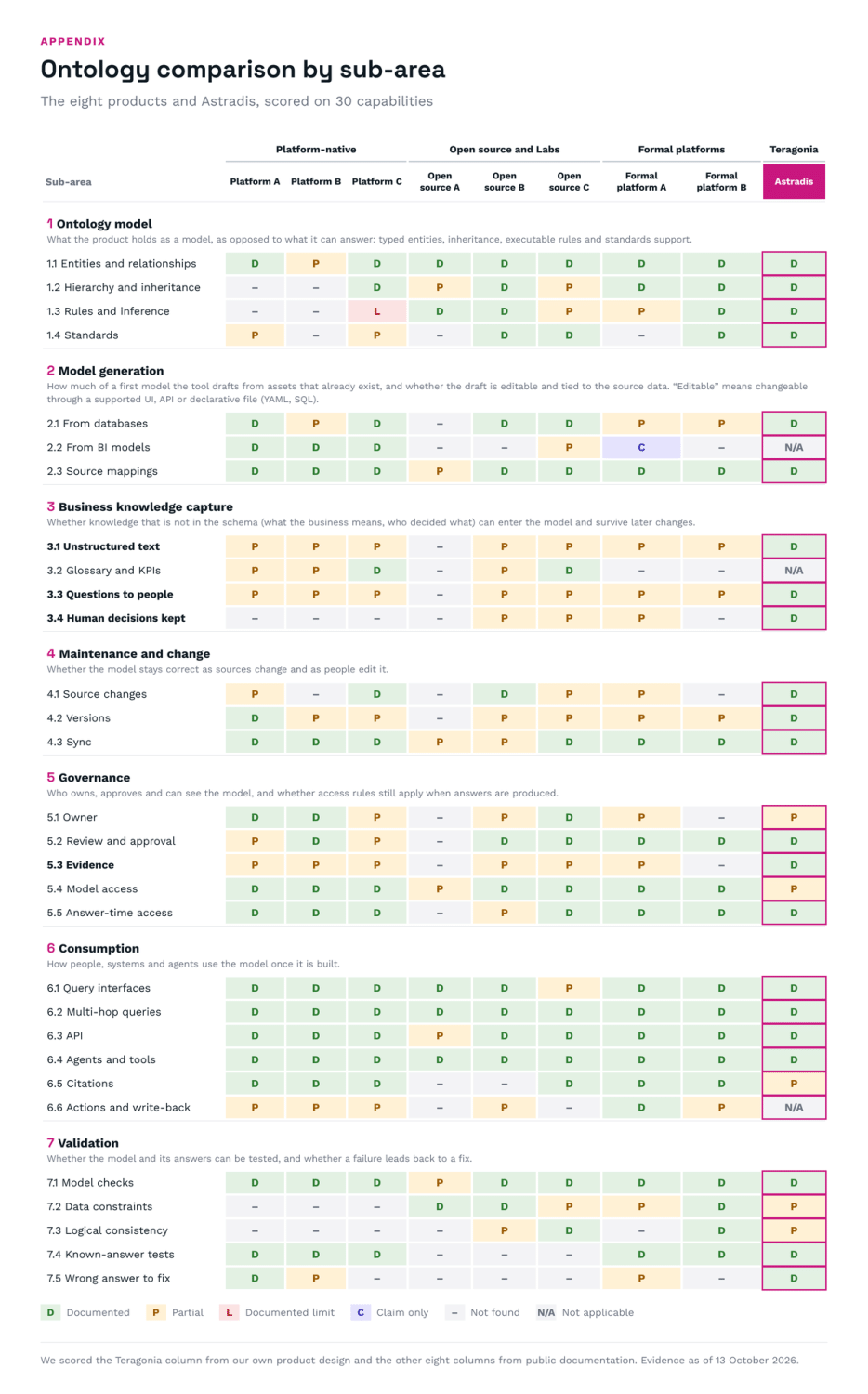
Exhibit 1. Teragonia fully covers 22 of the 30 ontology capabilities we checked. The best of the eight other products reviewed fully covers 18 capabilities.
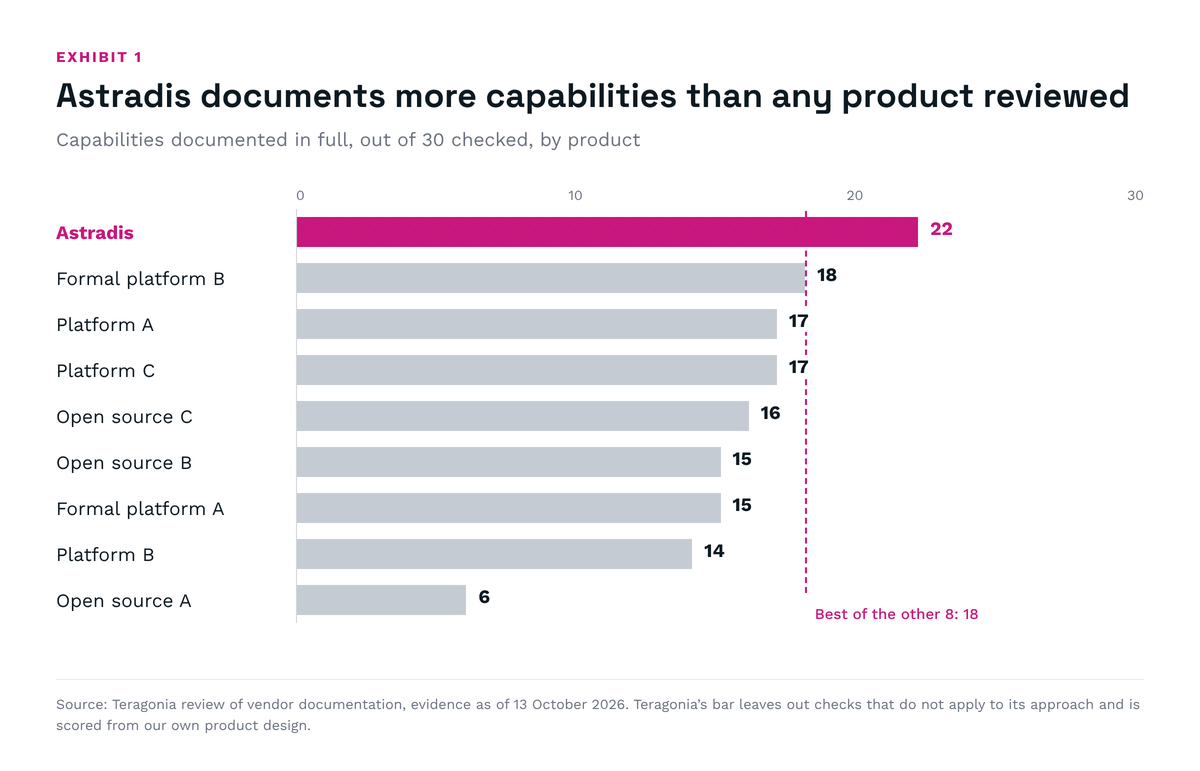
Astradis™ is Teragonia’s AI Operating System for PE-backed companies. Astradis™ builds every ontology from three sources: structured data from the company’s systems, unstructured documents and meeting notes, and the people who run the business.
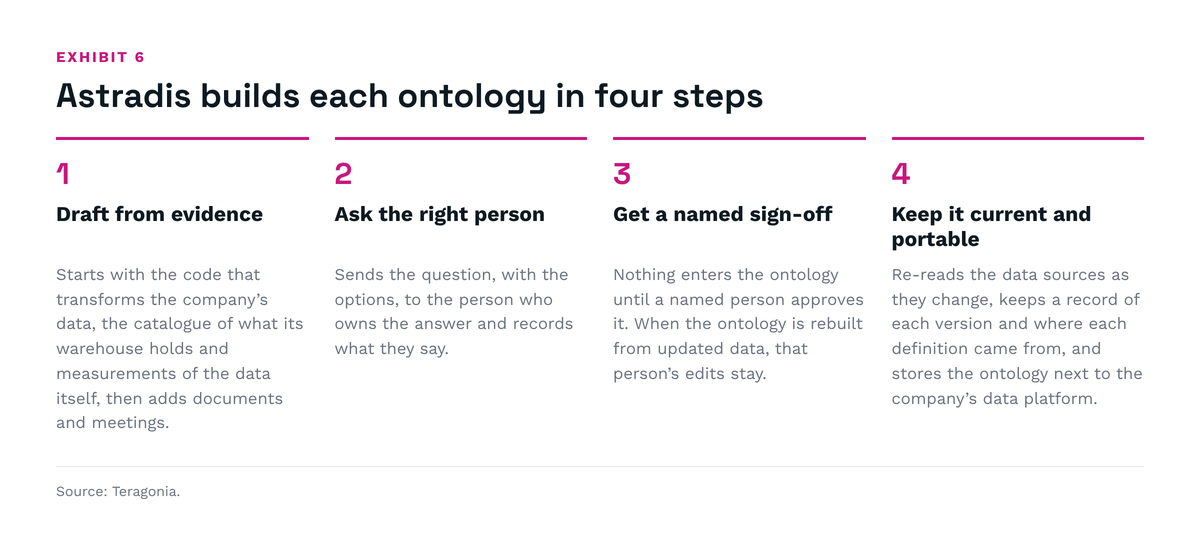
When the evidence cannot settle a definition, Astradis sends the question to the person who owns the answer and records the decision. Nothing enters the ontology until a named person signs off, and every decision survives when Astradis modifies the ontology. Automation does the drafting; people who have carried a P&L in the business do the signing off.
Every engagement also adds to a reference model for businesses that operate similarly, so the next company in a portfolio starts with the structure already in place, and reaches a defensible number faster.
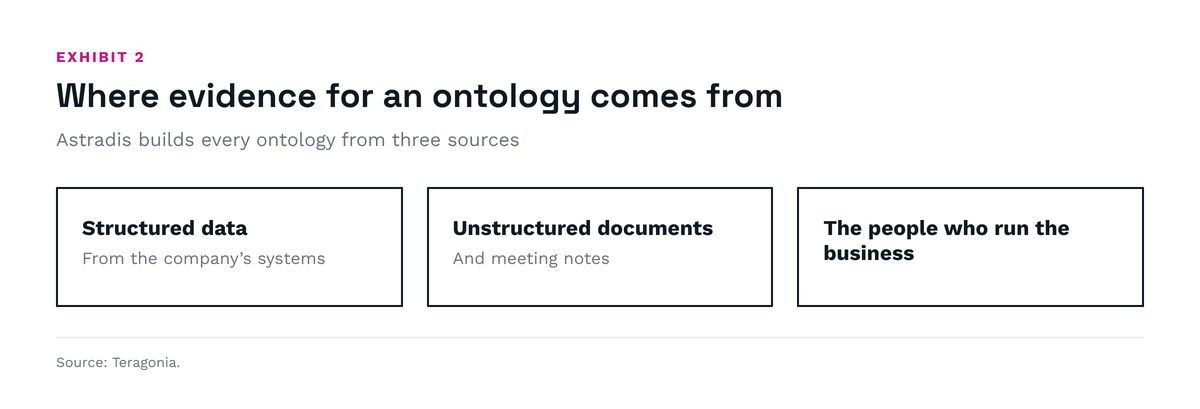
Bain’s 2026 midyear report finds that a deal that previously needed 5% annual EBITDA growth a decade ago now needs 12% to return 2.5 times invested capital over a five-year hold, and that value creation often gets lost in the middle of the hold period [10]. McKinsey sees the same pattern from the other side: for buyouts exited since 2019, about 6% of the total ending EBITDA margin came in the final year, 4% in the year before, and roughly 1% in every year earlier [6].
A team that spends its time reconciling numbers cannot deliver that level of expected growth.
Customer Spotlight
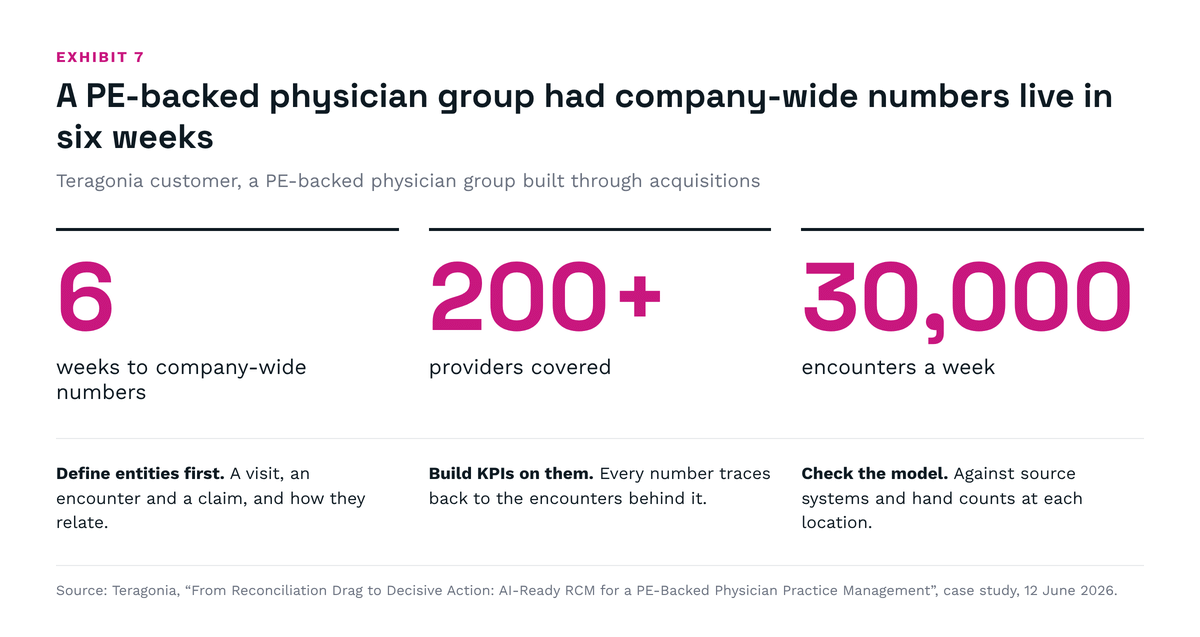
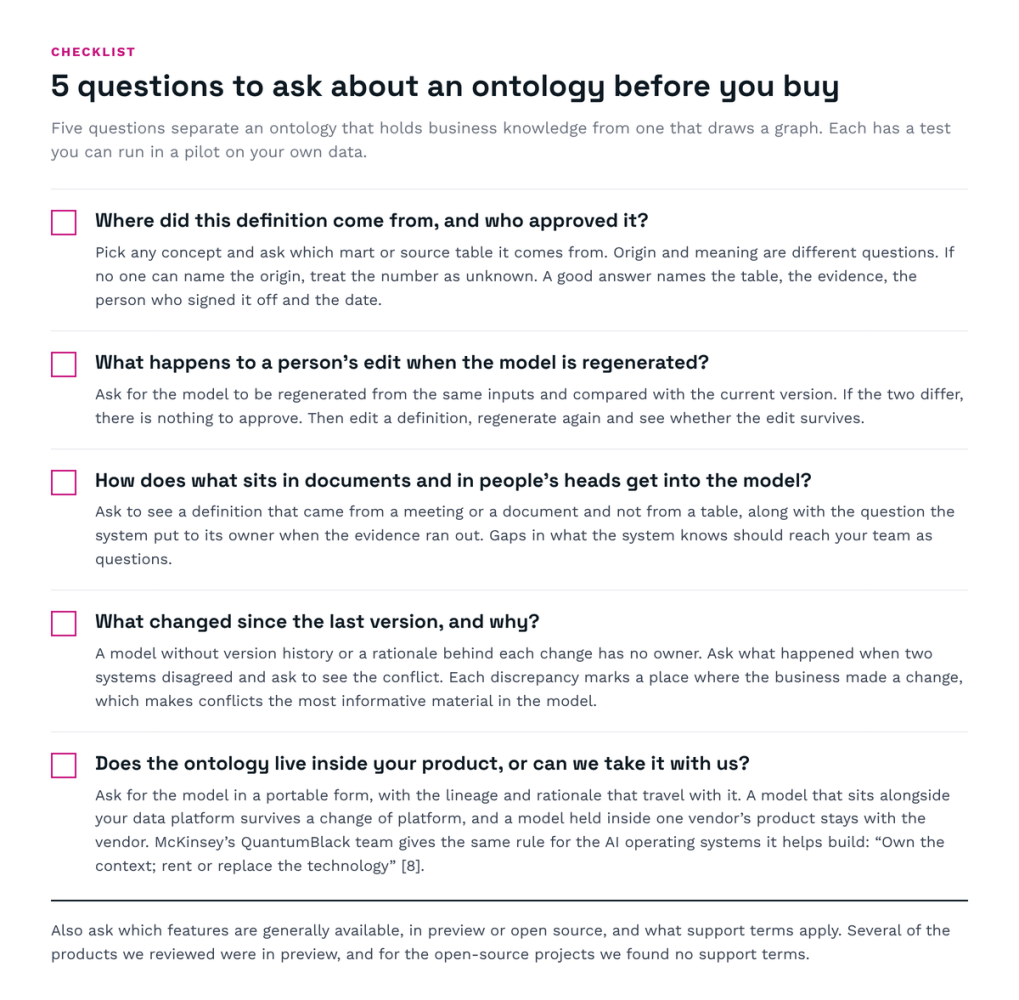
One Teragonia customer, a PE-backed physician group, was in that position: leadership spent their time on reconciling numbers instead of improving performance. With Astradis, Teragonia defined what a visit, an encounter and a claim meant, and had company-wide numbers live in six weeks across more than 200 providers [9]. In a hold where growth targets have more than doubled, six weeks to numbers that leadership trusts leaves the rest of the hold focus on the business. Buyers can test any ontology in a pilot on their own data. The checklist at the end of this paper gives five questions that show whether an ontology will reflect how your business really runs.
On the first Monday of every month, the leadership team of a sponsor-backed company reviews the prior month. Finance brings one revenue number; Operations a second; the sponsor’s portfolio report shows a third.
Each number is accurate by its own definition, yet none of them match. The first half of the meeting goes to debating which one is right. Now, consider adding an agent to this scenario.
The CFO asks the agent for last month’s revenue. The agent must pick one definition, so it picks one and returns a single clean figure with full confidence, but no one can say which of the three definitions it used.
The agent did not solve the problem; it hid it. With three numbers, the team could at least see that its definitions disagreed. With the agent, it gets one number with no sign of disagreement, and the company acts on it. An AI agent can read a company’s tables and still miss their meaning. It does not know which of several revenue figures finance has in mind, or whether “customer” means an account, a billing entity, or a household.
Forrester says an agent that answers a revenue question must know which measure applies, how customers and transactions relate, and what data it may use [1]. The first is a semantic layer question, the second is an ontology question, and the third is governance.
Companies are deploying agents faster than they are seeing returns, as McKinsey’s 2026 State of AI surveyshows [8]. We believe that missing definitions are one reason: an agent that guesses what a number means gives answers a company cannot safely act on.
Instead, a shared ontology gives every answer a reviewed and auditable definition to point to. Once an ontology exists, every agent or data source can leverage the definitions inside. A rule such as “only finance sees margin” attaches to the definition of margin, and applies wherever margin is used.
Building an ontology is the hard part, and maintaining it is harder, still. The people who can build an ontology are scarce, and a manually built ontology goes out of date as fast as the business changes, and much of the knowledge it needs sits in the memories of a few employees and leaves when they do [5].
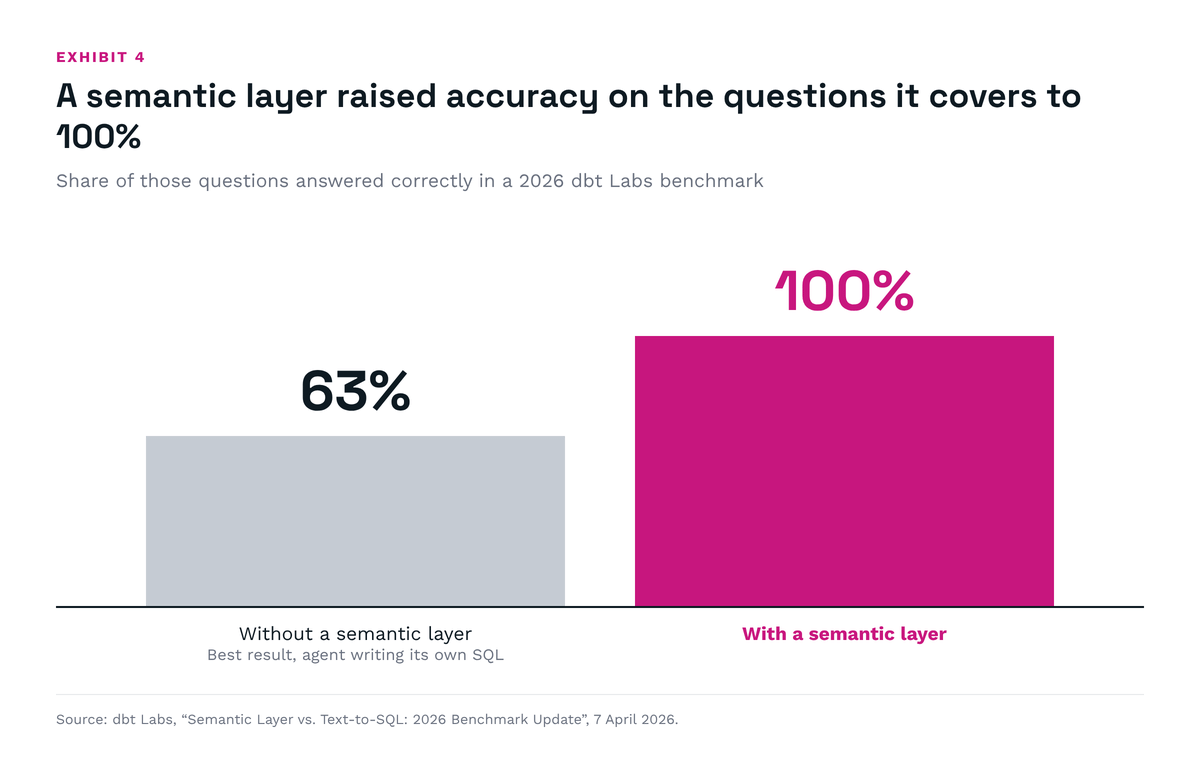
A semantic layer is precise but narrow. It answers the questions someone defined a metric for: in a 2026 benchmark by dbt Labs, AI agents that queried through a semantic layer answered 100% of the questions the layer covered correctly, against at most 63% when they wrote SQL directly [3]. Outside those metrics, the agent is back to guessing.
An ontology helps with the following:
Identity.The ontology decides when two records are the same thing. In one field services business, the billing system spelled technicians’ names differently from payroll. The ontology recorded each technician’s known name variants, plus a rule that a name shared by two people stays unattributed. That attached thousands of invoices that had no technician to the right person, without guessing. No metric definition can say that two records are one person.
Relationships.The ontology names the paths between things: In a healthcare business, a claim comes from an encounter, and in a field services business, an invoice from a work order. An agent answering a multi-step question follows those paths and does not invent joins.
Rules.The ontology states what is allowed: a work order belongs to exactly one site, and a payment applies to an invoice, never to a quote. A system can check every generated query against those rules before it runs, and reject or repair one that breaks them.
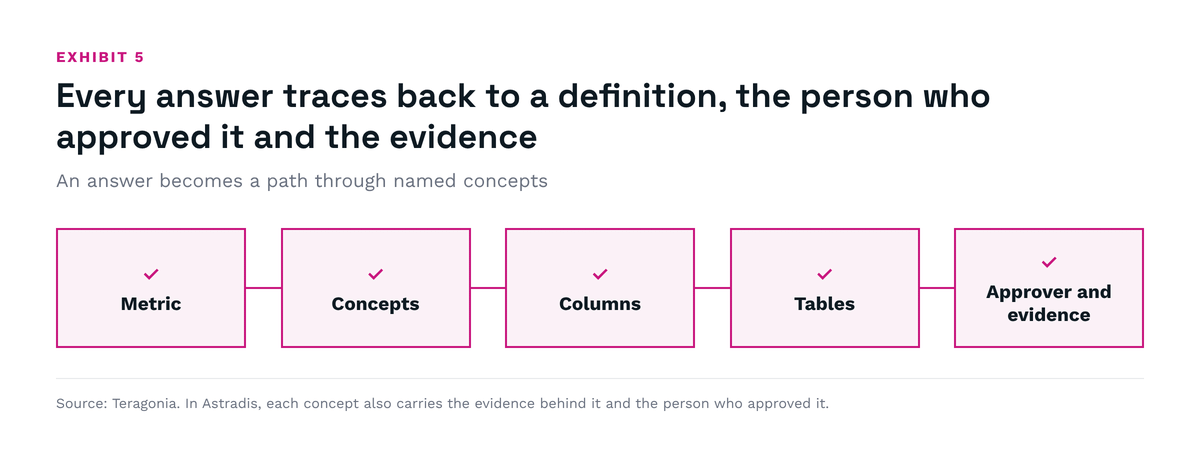
Auditability.An answer becomes a path through named concepts: the metric, the concepts it counts, the columns they map to and the tables behind them. In Astradis, each concept also carries the evidence behind it and the person who approved it, so when a lender asks where a number came from, the answer is on record.
A sponsor owns several companies, often assembled through add-ons, each with its own definitions of revenue, margin and customer. The problem from the Monday meeting repeats across the portfolio, and it surfaces when the stakes are highest: a lender package, an investment committee paper, a diligence data room.
A margin figure that no one can trace to a definition and an approver puts every other number in the package under scrutiny. Few companies are ready for that scrutiny. In Grant Thornton’s 2026 AI Impact Survey, only 9% of private equity respondents were very confident they could pass an independent AI governance audit within 90 days [7].
Our AI operating systems for PE based companies, Astradis, builds each ontology in four steps.
Below we address what our review found missing in the other products:
A query cannot decide how an ontology describes the business. This requires the work only a human can do.
Take a customer that operates under two brands the company acquired. The ontology can count it as one customer with two relationships, or as two customers that share a parent.
Both are defensible, but from the same data, they give different retention rates.
A second example shows how a wrong choice can look right on paper. An early draft for a field services client, a business that sends technicians to customer sites, added “Status” as a business concept: a single item holding open, closed and cancelled, linked to every work order. On a diagram it looked tidy. We removed it.
In that business, a work order moves through stages: scheduled, dispatched, completed and invoiced, and it can be cancelled along the way. “Status” is only the name of the stage a work order is in today; the business manages the stages, not the label. Left in, it would have linked to every work order and answered nothing. Modeled as stages with their dates, it answers what branch managers actually ask, such as how long completed jobs wait to be invoiced, by branch. Those stage dates are the same dates that made invoiced revenue ambiguous in the steps above.
Many choices work this way. Does a service visit end when the technician leaves or when the invoice clears? The answers depend on how the business runs and what management needs to measure. That is why the person building the ontology has to read a data schema and talk with the head of operations.
Take the five invoice dates from the CFO’s question. Here is how Astradis settles which one counts as invoiced revenue.
Astradis starts with three things the company already has: its data, the standards its industry uses to define and report numbers, and the business terms people use in documents and meetings. It builds a first draft of the ontology from all three. Before a term from a document goes in, Astradis checks it against the company’s data warehouse, so the draft holds only what the data can support.
Next, AI models try to break the draft. One model writes it, and the others look for mistakes. Every objection that holds up changes the draft, and the checks stop only when the models stop finding problems.
Only now does a person see it. Astradis marks the few points the data cannot settle, and the invoice date is one of them. All five columns are accurate, so no amount of checking picks a winner. A named expert who has carried a P&L in this kind of business chooses the date that counts as invoiced revenue. The expert reviews once and does not sit through every round.
That choice is locked in. Everything Astradis builds from the model comes from the signed version, and it fails if anything does not match, so what the expert approved is what the company gets. Astradis keeps checking the model against the warehouse so the two do not drift apart. When the company adds a system, a site or an entity, new tables arrive and Astradis rebuilds the model. The invoice-date decision survives every rebuild.
One company shows it working. A PE-backed physician group had grown through acquisitions, and its leaders spent more time reconciling numbers than improving performance. The fix started with entities, not formulas. Teragonia defined what a visit, an encounter and a claim are and how they relate, then built the KPIs on those definitions, so every number traced back to the encounters behind it. We checked the model against the group’s source systems and against hand counts at each location, and leadership trusted the numbers again. It went live in six weeks across more than 200 providers and 30,000 encounters a week [9].
Technical staff can read the tables, and they cannot say whether a work order belongs under a branch or under a route. Someone who has carried a P&L in field services, financial services, healthcare or industrial services can say. In our experience, much ontology work has no one in that seat.
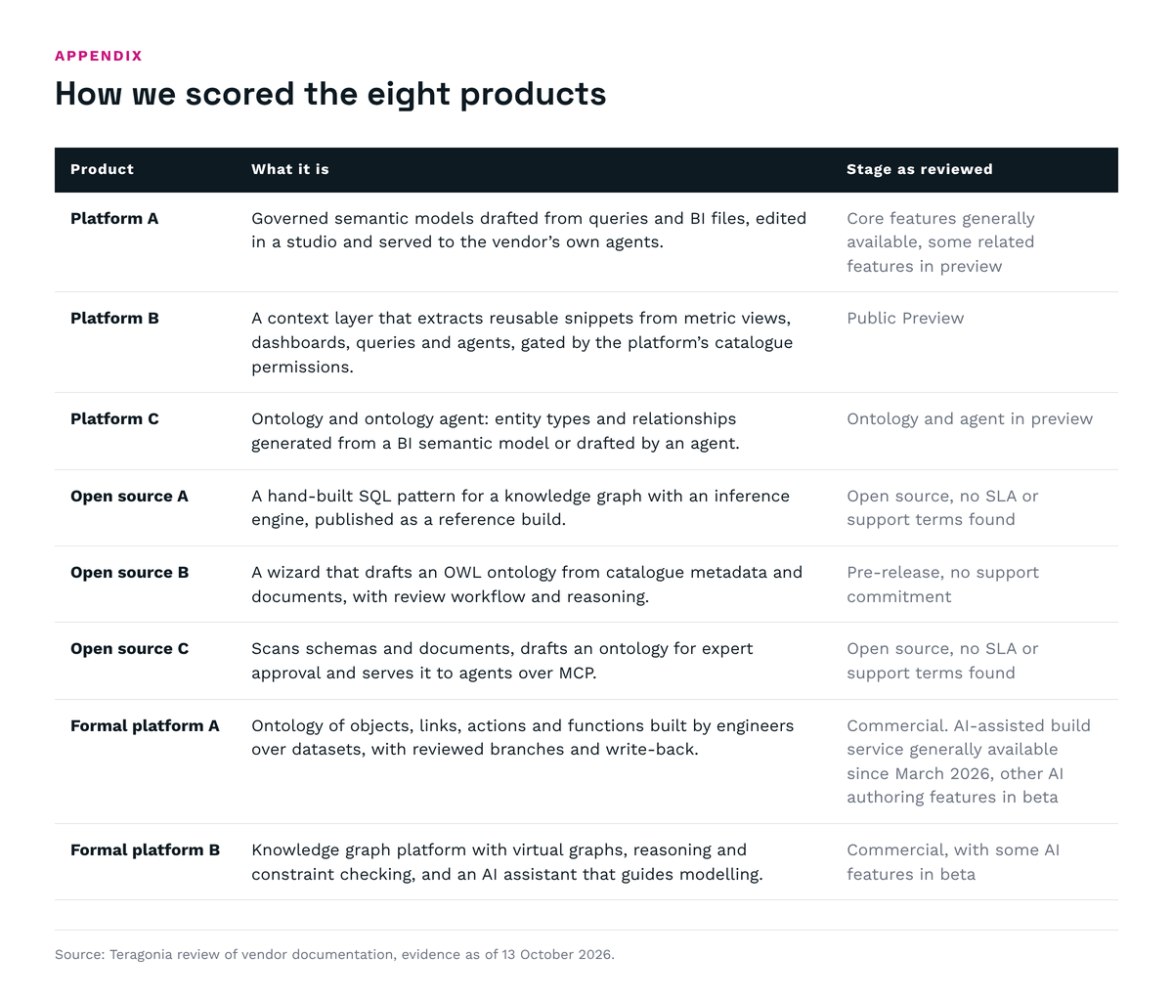
We read the public documentation for eight ontology products and checked 30 capabilities that a buyer needs across the life of an ontology, from how it is drafted to how it is tested. Results describe each product as of 13 October 2026, and products announced or updated after that date are not scored. We scored Teragonia’s column from our own product design.
Exhibit 8. The eight products document the checks on using the ontology best and almost none of the business knowledge checks.
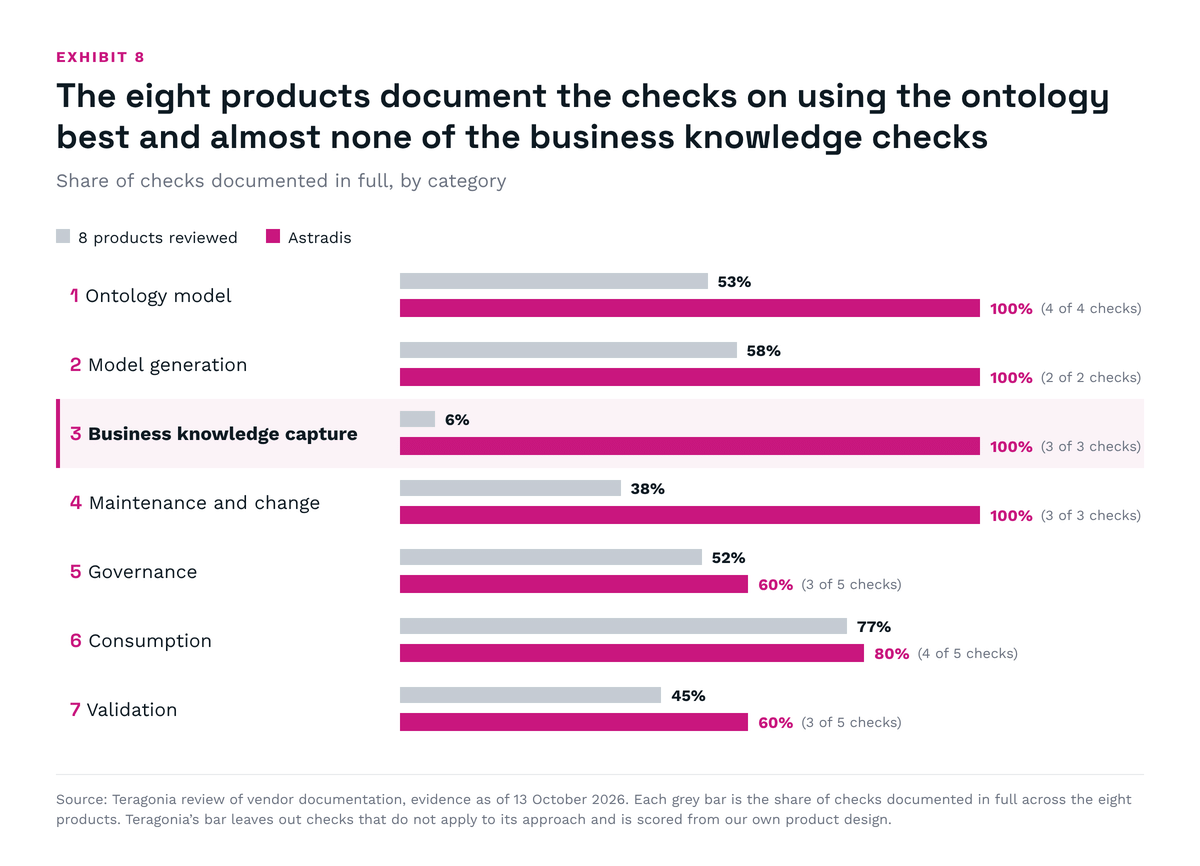
The eight products document the technical basics best. In full, they cover 77% of the checks on how people and agents use the ontology, and 52% to 58% of the checks on how it is modeled, drafted and governed.
Business knowledge capture is the exception. Across the eight, only 2 of 32 checks are documented in full, and both are about glossaries and KPI definitions, the knowledge a business has already written down. None documents in full how a product learns from documents, asks people to settle an unclear definition, keeps a person’s decision when the model is rebuilt, or records the evidence behind a definition. Teragonia is documented in full on all three business knowledge checks that apply to it.
We trail on five checks: ownership (5.1), model access (5.4), citations (6.5), data constraints (7.2) and logical consistency (7.3). A buyer whose first need is formal reasoning or write-back should start with a formal ontology platform.
The matrix behind these results and the descriptions of the eight products are in the appendix.
The primary differences between Astradis and other platforms we compared are:
1. Expert input to validate construction.It is this ‘white glove’ treatment to our approach that, in our experience, yield far superior results than self-serve or fully automated ontology builds
2. Version comparison.This facillitates our ability to audit changes. Also, full lineage history and audit which addresses the who, when, and why.
By our own scoring, Teragonia is the only one of the nine ontology products in this review that is documented in full on four capabilities. They decide whether an ontology reflects how a business really runs.
The four capabilities that matter:
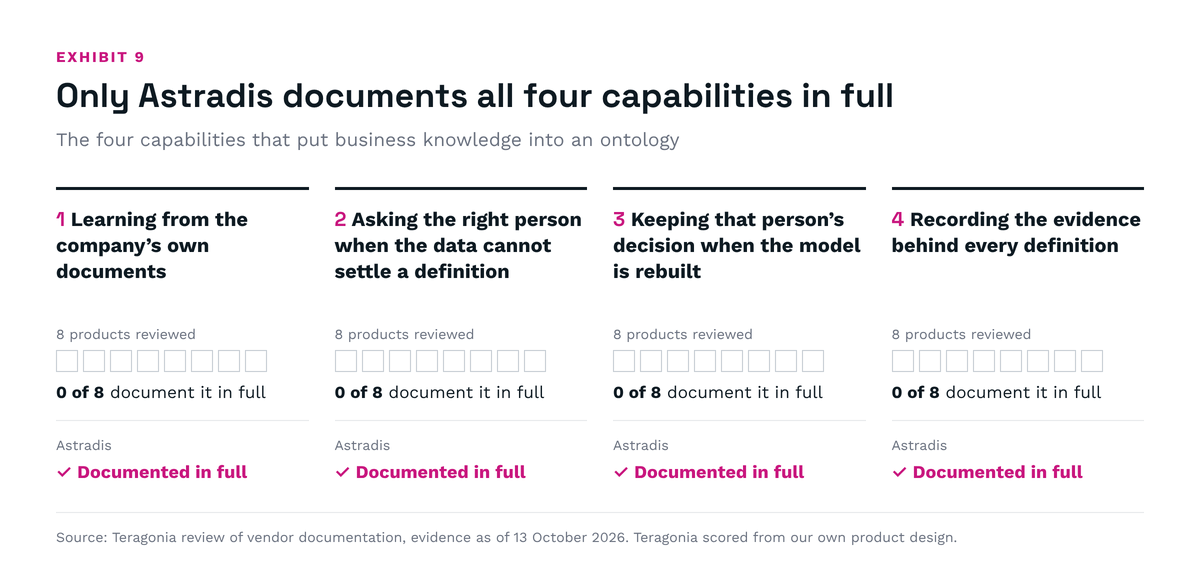
The other eight products cover these in part at best, and some cover them not at all. None covers any of the four in full.
Take the five invoice dates. The data cannot pick one, so Astradis asks the person who owns the answer. That person decides once. Astradis records the decision with the evidence behind it, and the decision holds through every rebuild. When a lender asks where the revenue figure came from, the answer exists: this column, chosen by this person, for this reason.
Teragonia also gets faster with every company. Each engagement adds to a reference model organized by business operating model. A chain of ten dental clinics and a chain of ten burger restaurants sell nothing alike, and they generate EBITDA the same way: revenue is earned inside four walls, site-level costs sit against it, and shared procurement and overhead are allocated from above. The next company in a portfolio starts from that structure on day one. Because the companies share underlying definitions, margin means the same thing in every board pack, and a number from one company can sit beside a number from another in a lender package without a footnote explaining that they were measured differently.
For some needs, another approach fits better.
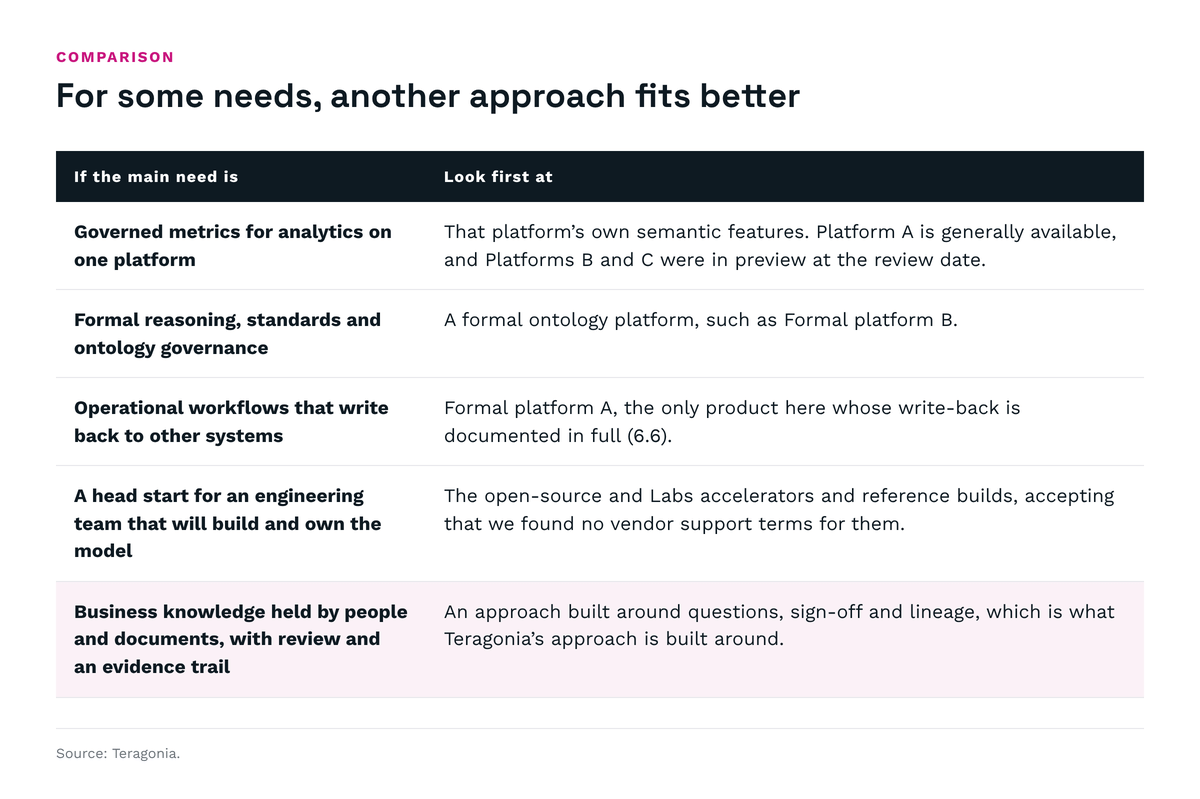
Product facts change quickly, so read each cell with its date. The products are named in the key under Exhibit 1. If you represent a vendor covered here and believe a cell is wrong, send the source to your Teragonia contact and we will review it and correct the paper.
The ontology has become the core of the context layer. Gartner advises data and analytics leaders to establish a context layer [4], and every major platform has shipped or previewed its own. Our review shows that the market has solved the mechanics. Querying, mapping to source tables, permissions and serving agents are documented across most of the eight products. What remains open is where the definitions come from, who decides them and how those decisions last.
Return to the Monday meeting. The semantic layer fixes the revenue formula, and an ontology built on evidence and signed by named owners fixes what that formula counts. The three revenue numbers resolve into one, with an approver and a date, and the agent that answers the CFO uses that definition and shows its source. For a business leader, the test is simple. Ask how each definition is evidenced and approved, and what happens to a person’s decision the next time the model is regenerated. A product that cannot answer will return a graph, and your agents will inherit its guesses. For a technical leader, the four capabilities in the bold rows of the matrix are the ones a documentation review cannot confirm from outside, so test them in a pilot on your own data. For a sponsor, a definition layer built once and reused across companies turns the work from a project into an asset.
Teragonia’s ontology builder, part of the Astradis platform, is built around the gap this paper describes. It treats the business’s own documents, meetings and people as evidence, asks owners the questions the evidence cannot settle, and keeps their decisions through every regeneration.
Appendix
Data model: The unified data layer that brings a company’s source systems into one structure. The other three layers build on it.
Ontology: A model of how the business works: its entities (customer, site, work order), how they relate, when two records are the same thing and the rules that always hold. The semantic layer’s metrics refer to its concepts.
Knowledge graph: The business’s own data stored in the ontology’s structure. Each customer, invoice and service line is a node, linked to the things it relates to.
Semantic layer: Governed definitions of metrics and dimensions, such as revenue, churn and active customers. Tells a dashboard or an agent how to calculate a number.
Context layer: Everything an agent reads about meaning before it answers: the semantic layer, the ontology and the knowledge graph [2].
About Astra Labs
Astra Labs is a business unit of Teragonia that brings applied AI to complex enterprise problems and workflows. Astra Labs deploys directly inside every client’s environment and moves fast from the first conversation to AI running in production. Every engagement is priced as a fixed fee and held to a guaranteed outcome, and every Astra Labs build is owned by the client.

Sebastien Roy, Ph.D. is a Senior AI/ML Engineer at Teragonia. He is a theoretical physicist, entrepreneur and applied AI engineer with more than a decade of experience across machine learning, operations research, quantum computing, graph theory and combinatorial optimization. He was previously Director of Data Sciences at Wheels Up, where he scaled a data science team from 2 to more than 18 scientists, and co-founded Lean Systems, a venture accepted into Techstars NYC. He holds a Ph.D. in Physics from the Université de Sherbrooke.

Gert De Geyter, Ph.D. is a Staff AI/ML Engineer Teragonia . He is an applied AI leader with more than a decade of experience taking machine learning from research into production across financial services, energy and healthcare. He was previously Machine Learning Lead at Deloitte Consulting, where he built and led a global AI practice of more than 40 data scientists and engineers. He holds a Ph.D. in astrophysics from Ghent University and is a Guest Professor in Columbia University’s Applied Analytics program.
Sources:
Forrester, “Microsoft FabCon 2026: Enterprise AI Needs A Governed Context Layer, Not Just Data”, Indranil Bandyopadhyay, 6 October 2026. forrester.com/blogs/microsoft-fabcon-2026-enterprise-ai-needs-a-governed-context-layer-not-just-data/
Forrester, “The Next Evolution Of AI Will Rely On Context Layers”, Boris Evelson and Indranil Bandyopadhyay, 20 August 2026. forrester.com/blogs/the-next-evolution-of-ai-will-rely-on-context-layers/
J. Ganz and B. Perigaud (dbt Labs), “Semantic Layer vs. Text-to-SQL: 2026 Benchmark Update”, 7 April 2026. docs.getdbt.com/blog/semantic-layer-vs-text-to-sql-2026
Gartner, “Gartner Says Lack of Semantics Causes Inaccurate AI Agents and Wasted Spending”, press release, 11 May 2026. gartner.com/en/newsroom/press-releases/2026-05-11-gartner-says-lack-of-semantics-causes-inaccurate-artificial-intelligence-agents-and-wasted-spending
T. Tung and P. Roussiere (Accenture), “Tacit Knowledge Is Your Next Competitive Moat”, California Management Review Insights, 16 March 2026. cmr.berkeley.edu/2026/03/tacit-knowledge-is-your-next-competitive-moat/
McKinsey & Company, “Global Private Markets Report 2026: Clearer view, tougher terrain”, June 2026.
Grant Thornton, “Private equity insights: 2026 AI Impact Survey Report”, 2026. Survey of 950 business leaders. grantthornton.com/insights/survey-reports/private-equity/2026/private-equity-insights-2026-ai-impact-survey-report.html
A. Padhi, B. Elliott, D. Swan, K. Baroudy and V. Sohoni (QuantumBlack, AI by McKinsey), “The AI operating system: A new way for CEOs to run the enterprise”, October 2026. Survey figures from D. Tinkoff, L. Van der Veken, M. Chui and T. Balakrishnan, “The state of AI in 2026: On the road to ROI”, McKinsey, 25 August 2026.
Teragonia, “From Reconciliation Drag to Decisive Action: AI-Ready RCM for a PE-Backed Physician Practice Management”, case study, 12 June 2026. teragonia.com/case-studies/from-reconciliation-drag-to-decisive-action-ai-ready-rcm-for-a-pe-backed-physician-practice-management/ [10] H. MacArthur, R. Burack, A. DeMol, A. Schmitz and B. Krim (Bain & Company), “Control the Controllable, Weather the Rest: Private Equity Midyear Report 2026”, 8 June 2026. bain.com/insights/private-equity-midyear-report-2026/
Our core analytics and AI platform drives informed decision-making with enhanced clarity and focus, and rapidly unlocks enterprise value
Core Features:

Integrate data from multiple source systems effortlessly
Critical for breaking down silos and creating a unified view

A secure, centralized cloud hub for all your data insights
Foundational for reliable decision-making and enterprise-wide alignment

Visualize complex data through easy-to-understand dashboards
Empowers leaders with actionable insights

Reverse ETL capabilities enriches your data and ensures your data flows exactly where it is needed for function teams to act on
Enables real-time, action-oriented data flow


BS International Business | American University of Paris
BS Computer Science | American University of Paris
Seasoned DevOps and infrastructure engineer with expertise in AWS, Kubernetes, and Terraform; led cloud migrations and scalable infrastructure projects at Sfara, FanDuel, and Kickstarter.
With over 15 years of experience in small and medium-sized startups, Scott is a seasoned expert in designing, optimizing, and maintaining robust, scalable, and secure infrastructure. He specializes in automation and embedding security from the ground up, consistently delivering reliable systems tailored to meet dynamic business requirements.
Prior to joining Teragonia, Scott made a significant impact at Sfara, where he built the company’s entire infrastructure from scratch. He engineered systems capable of supporting hundreds of thousands of users with seamless scalability, implemented automated development pipelines, and introduced observability tools to monitor and manage resources effectively. Additionally, Scott led the infrastructure team in achieving ISO27001 security certification, ensuring security was integrated into every aspect of the system and transforming it into a critical asset for business-to-business operations.
Beyond his technical expertise, Scott has a proven track record of managing and mentoring high-performing teams. As a Senior DevOps Engineer at FanDuel, he gained invaluable experience in scaling infrastructure and optimizing resources to support millions of daily users, aligning technological capabilities with organizational goals.

Master’s in Human Resources | University of Illinois
Bachelor’s in Management | Loyola University
Former Financial and Operations Manager at Houlihan Lokey, Golin Harris, and MSL Group.
Jack is a highly driven, cross functional professional with extensive experience in operations and administration.
Prior to joining Teragonia, Jack held financial and facilities management roles for Houlihan Lokey, MSL Group/Publicis, and Golin Harris in which managed and created processes and trainings for multiple functional areas ensuring operational and administrative procedures were well planned, efficient, cost-effective, and aligned with business objectives while ensuring initiatives, internal events as well as client events propelled employee and client engagement.
Jack holds undergraduate degrees from University of Illinois and Loyola University Chicago and has completed graduate certificates in Business Administration, Strategic Human Resources, and Operations at Cornell, CUNY-Buffalo, and University of Illinois and is in the process of completing a Master’s in Human Resources at Loyola University Chicago’s Quinlan School of Business.

MS Analytics | Georgia Institute of Technology
BS Management Information Systems | Oklahoma State University
Former analytics engineer at Cyderes and ConocoPhillips with a Master’s in Analytics from Georgia Institute of Technology and a Bachelor’s in Management Information Systems from Oklahoma State University
Mason is an Analytics Engineer with deep experience in data analytics, business intelligence, machine learning, and cybersecurity. He brings a proven track record of leading analytics engagements spanning architecture, insights, visualizations, and delivery.
Before joining Teragonia, Mason was a Senior Analytics Engineer at Cybersecurity MSSP CYDERES where he built a scalable, standardized, and secure analytics architecture for over 300 clients across many industries and consulted with them to deliver insights through bespoke data driven solutions. In addition, he managed the data delivery of the insight platform leveraged by the Security Operations Center to respond to incidents in a timely and effective manner.
Prior to joining CYDERES, Mason worked in ConocoPhillips’ Analytics and Innovation Center of Excellence holding varied roles within the Data Analytics organization from Data Engineering, to Business Intelligence, and Data Science. He delivered robust data solutions in all operating units for various functions including Engineering and Production, Finance, IT, and more. Including projects to standardize cost and production data across operating units.
Mason started his career at The Williams Companies in cybersecurity and transitioned to cybersecurity at ConocoPhillips where he found his passion for Data Analytics through SIEM management, detection engineering, and threat intelligence.

Bachelor’s in Finance & Accounting | Georgetown University
Former analytics engineer at Houlihan Lokey and financial analytics at JP Morgan Chase with a Bachelor’s in Finance & Accounting at Georgetown University
Grace is a seasoned analytics engineer with specialized expertise in crafting and implementing analytics solutions that drive agile, informed executive decisions in M&A and value creation for private equity-backed companies.
Before joining Teragonia, Grace was a part of the data science and business analytics team at Houlihan Lokey. She has excelled in harmonizing, enriching, and analyzing data from diverse sources, providing key insights that enabled private equity investors and portfolio company executives to make rapid, data-driven decisions across the investment lifecycle. She has developed novel analytics solutions, including deal sourcing and evaluation tools for platform investments that employ a buy-and-build or de novo growth strategy, as well as post-close value creation and KPI reporting tools for operators and management teams.
Grace has also worked at JPMorgan Chase & Co. in the Global Finance and Business Management rotational program, where she built analytics solutions to evaluate banker attrition and KPI reporting within the Global Private Bank.