By Thomas Thayyil Thomas, CEO and Co-founder, Teragonia
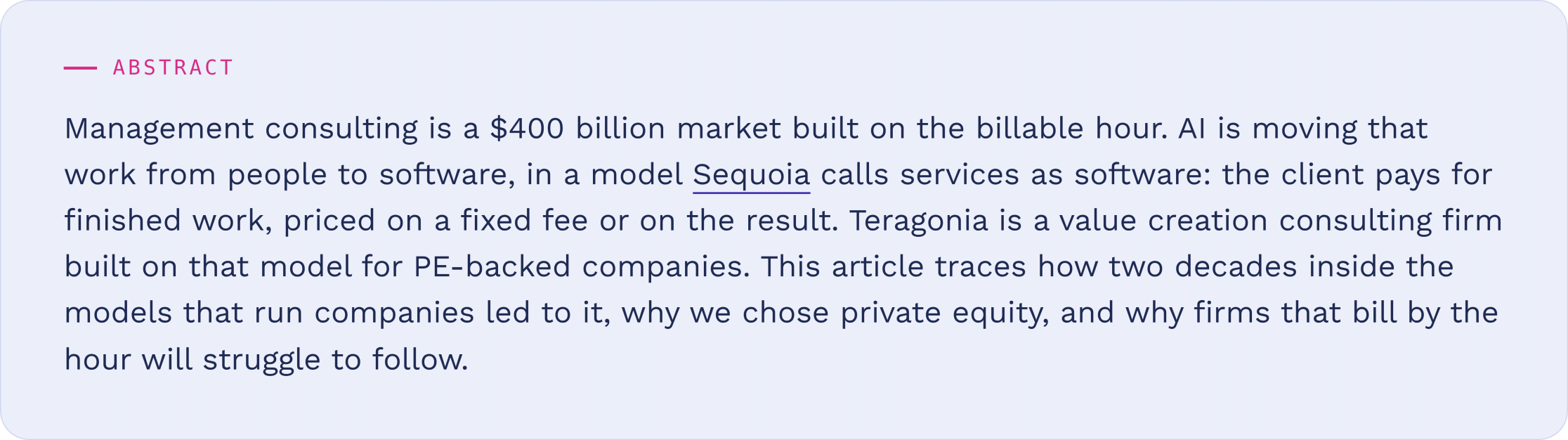
CEOs of three major professional services firms serving the mid market told me recently that they expect this shift from services as software within 12 to 18 months, and I think they are right.
Early in my career at EY, I audited exotic commodity derivatives modeled inside Excel files of well over 500 MB. These files took several minutes to open. In fact, one valued a multibillion-dollar natural gas contract on a synthetic price, built before a liquid market for natural gas existed, with roughly 20 counterparties and hundreds of millions of dollars riding on it. The most valuable decision tool in the company ran on Excel and lived inside the memories of a few people.
These massive files planted the question that became Teragonia.
What if these models lived outside the spreadsheet, connected live to a company’s data, its markets, the macroeconomy, and capital markets, and learned in real-time from every decision?
Connected and live, this ‘living’ model would show management their current state, what comes next, and what to do about it. Operators know their business better than any consultant, so why not give them that view in real-time, and let them make the calls?
In April, 2023 we started Teragonia on Astradis, the AI operating system purpose-built for PE-backed companies. With Astradis, agents do the work, experts supply the judgment, and the client benefits from the finished result.
Today, Astradis runs inside the portfolios of some of the world’s leading private equity firms.
I joined EY at 30, later than most of my peers, after a career lecturing in finance. As far as industry, I selected energy deliberately. This one industry holds nearly every business model there is: refineries, petrochemical plants, offshore engineering projects, LNG terminals, pipelines, oilfield services, shipping, fuel retail, and the trading desk. My work took me deep inside every single one.
My first month was anything but glamorous: 180 bank accounts reconciled manually for one of the largest commodity traders in the world. To escape the tedium of bank reconciliations, I volunteered for the derivatives audits that no one wanted, which gave me a front row seat to the institutions that move markets, from Morgan Stanley and J.P. Morgan to Vitol, Trafigura, the super majors and national oil companies, working alongside people who knew considerably more than I did.
From audit, I moved into M&A due diligence, integration, and value creation: more than 100 transactions worth over $100 billion, from founder-owned businesses with single-digit EBITDA to multibillion-dollar cross-border deals, carve-outs, restructurings, and IPOs. With engineers and PhDs, I built economic digital twins of businesses and mega projects, or living replicas of their economic relationships, kept in step with the real thing through its data. One digital twin carried more than 40,000 variables. My rule for all of them: the math doesn’t count until it shows up as cash.
Large language models arrived as we were forming Teragonia, and they made practical a model I had spent two decades assembling one company at a time.
Moving to Houlihan Lokey brought me into private equity, where sponsors placed hundreds of millions of dollars behind companies they expected to scale three to ten times in a compressed hold, without a public company’s people or technology. For years, technology vendors chased the large enterprise and overlooked PE-backed companies, an opportunity for anyone who can speak the language of EBITDA and technology.
Private equity also spreads what works.
Sponsors have capital at stake, push change from the board, and move fast. A playbook that worked at one portfolio company gives the next a head start, with the sponsor connecting the dots and making introductions.
Sai Mali A., Ph.D., our Chief AI Officer, is the most gifted mathematician I know, a decision scientist with the courage to take AI where its limit. Together, we founded Teragonia with the sole purpose of bringing decision science and AI to PE-backed companies.
The numbers inside the gas contract model example could not be easily explained; the reasons lived with the people who built it. ‘Context’ is what gives meaning to the numbers: the industry, the function that owns every number, and how the business operates. Without it, AI is making a guess. In a 2026 dbt Labs benchmark on insurance data, two current models answered only 63% and 51% of the questions correctly from raw tables. Given the company’s definitions, both answered 100% of the questions those definitions covered.¹
PE-backed companies make context hard to assemble. Few can hire a public company’s depth in finance, revenue, and operations, and their operators want to know first thing what needs action every morning. In a roll-up, the data is scattered as well. For example, one company we met runs 37 accounting ERPs, all of which must reconcile to one set of financial statements that hold up in diligence.
Context is half the challenge. The other half is human.
Business rules, such as how bids are won in a closed room of big-box procurement managers, walk out the door with the people who hold them. One animal protein company gave us eight definitions of material margin in a 30-minute meeting. A transportation company debated what “location” meant: depot, warehouse, lease, cost center, parking lot, or maintenance facility?
Storing that meaning is a technology problem. Making it reliable is an art. Automating it is a science.
Asking people how they think, and getting teams to agree on one definition, since two defensible models can report different retention rates from the same data.
Astradis combines all three into four layers: a reconciled data model, approved definitions, ontologies that hold tribal knowledge, and a live knowledge graph tied to the published financials. Together, they comprise the data foundation and context layer.
Our patent-pending Data Modeling Autopilot drafts the model from thousands of tables for our engineers to approve, so the layers take weeks, and each add-on joins within two to four weeks of close. Every answer is checked against the governed definitions before anyone acts on it, so when a lender or buyer asks how a number was made, the answer is already on record.
“Teragonia built the lineage, definitions and semantic ontology that foundation required, and the team moved about as fast as I can envision from a data perspective. Our infrastructure now operates at a new level of sophistication and is fully operational for AI.”
Gabriel Iatarola, Chief of Staff and VP of Strategy, US Heart & Vascular, an Ares Management portfolio company
Recently, McKinsey described the AI operating system as the enterprise’s “second brain”: a semantic layer of definitions, rules, and relationships, with analytics and agents on top.² Its advice to CEOs: own the context, rent or replace the technology. Every one of those layers runs inside Astradis, which we call the connected brain, within weeks of kickoff and under a 99.9% uptime guarantee.
Our clients always own their data and context layer, and nothing built on it is shared.
Here is a (real) example of how this works in practice.
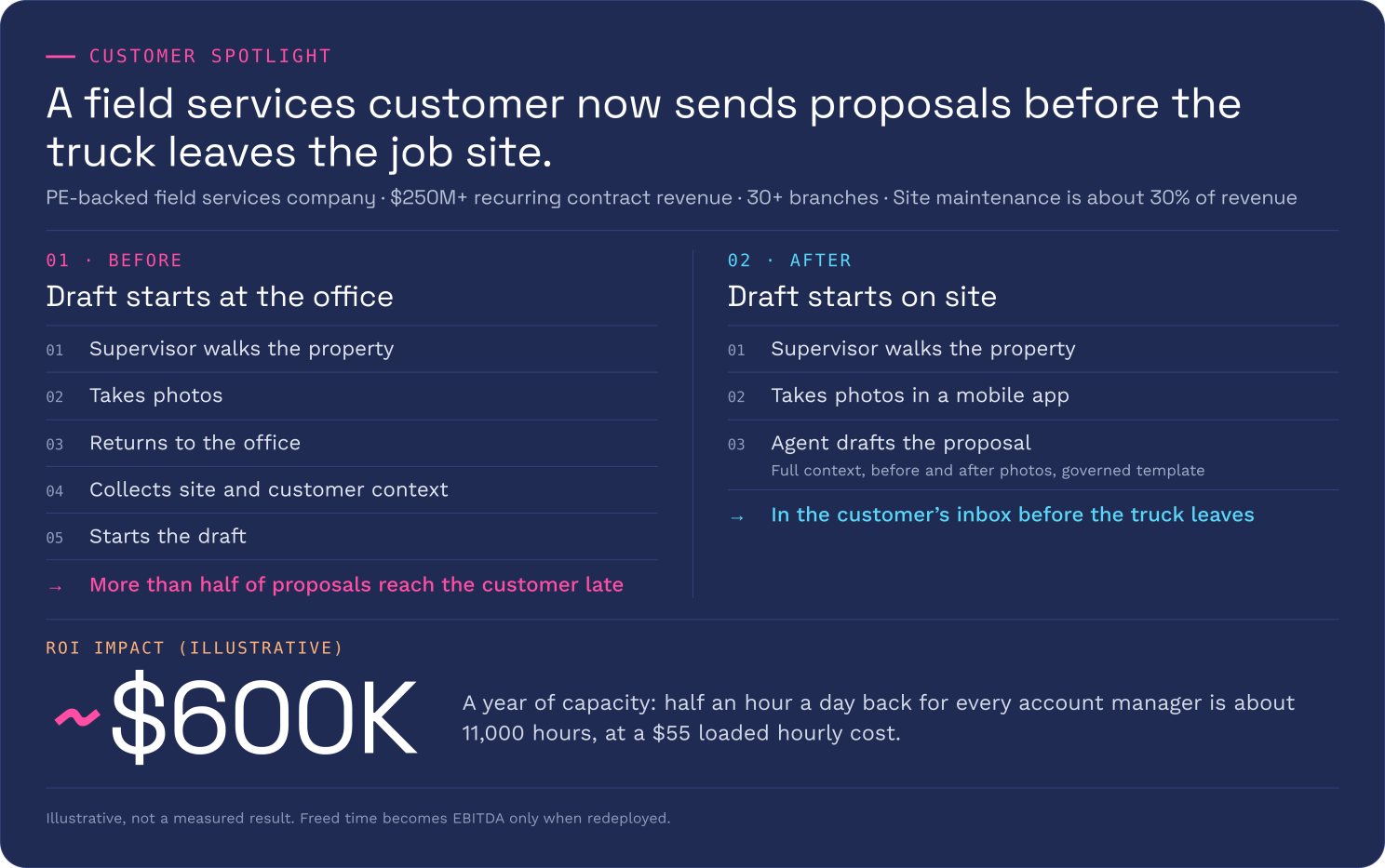
A PE-backed field services company earned about 30% of its revenue from site maintenance. Each proposal waited until a supervisor had walked the property, taken photos, returned to the office, and gathered context. More than half reached the customer late, and every late proposal lowered the odds of winning the work. After working with our team, now the supervisor takes photos in a mobile app, and an agent drafts the proposal with full context in a governed template. It is in the customer’s inbox before the supervisor climbs back into the truck.
People ask whether we are a product company or a services company. We are both: services as software.
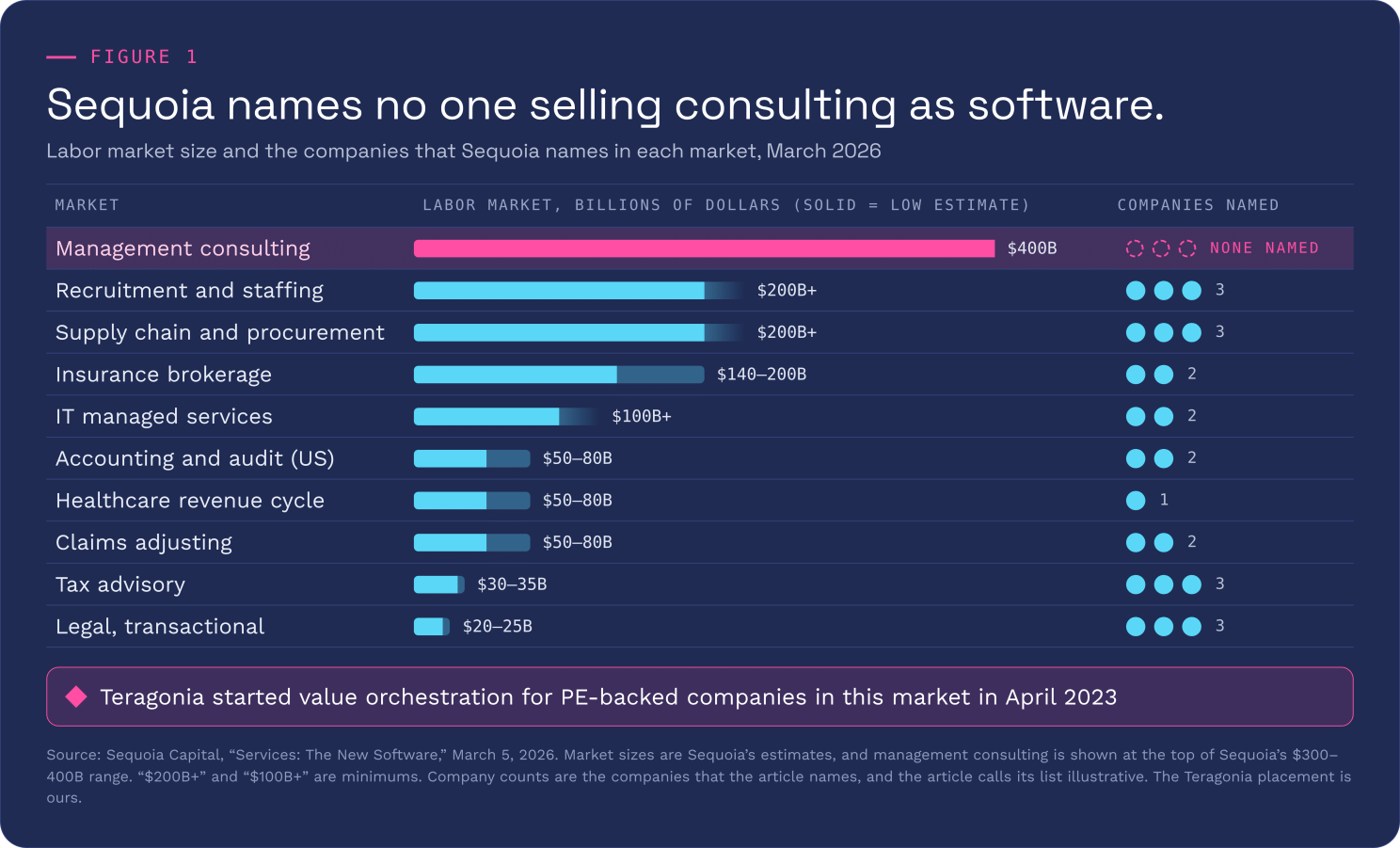
Sequoia’s Sonya Huang and Pat Grady wrote that the market for AI is the services budget,³ and their colleague, Julien Bek, added that each model improvement threatens those who sell the tool and helps those who sell the work, with six dollars spent on services for every dollar on software.⁴ 8VC calls software embedded judgment.⁵
Startups already sell finished work in insurance brokerage, tax, and IT support. Management consulting, a $400 billion market, is the largest on Sequoia’s list. It is mostly judgment, the hardest work to put into software, and Sequoia names no one selling it as software (yet).
Teragonia puts that judgment into software.
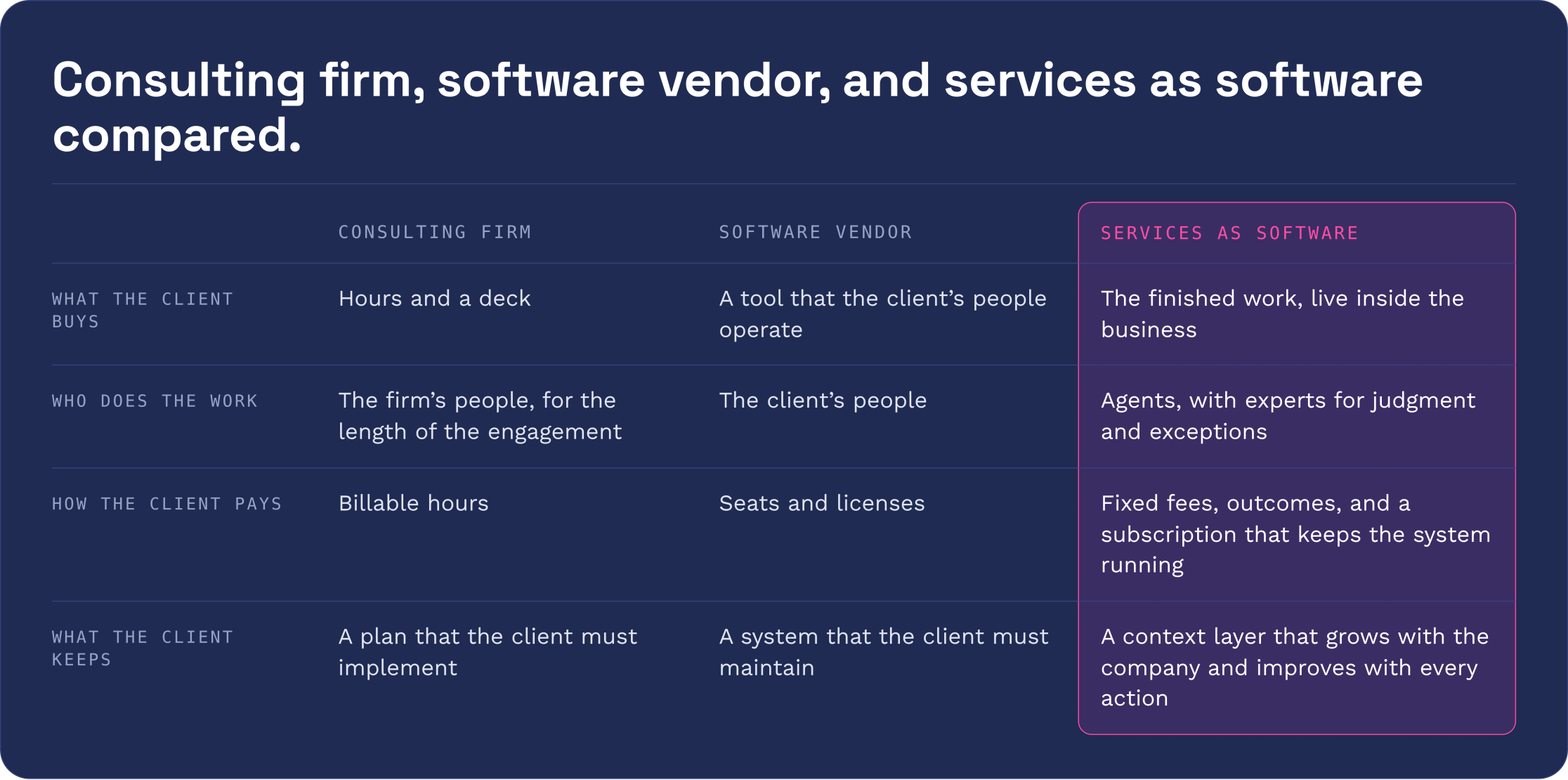
We built Astradis first and our Value Orchestration Engineering (VOE) practice around it, which is why what we sell is an outcome: intelligence, action orchestration, and EBITDA. Our VOE team learns how the client’s best operators decide, teaches Astradis to make the same calls, and reviews its output.
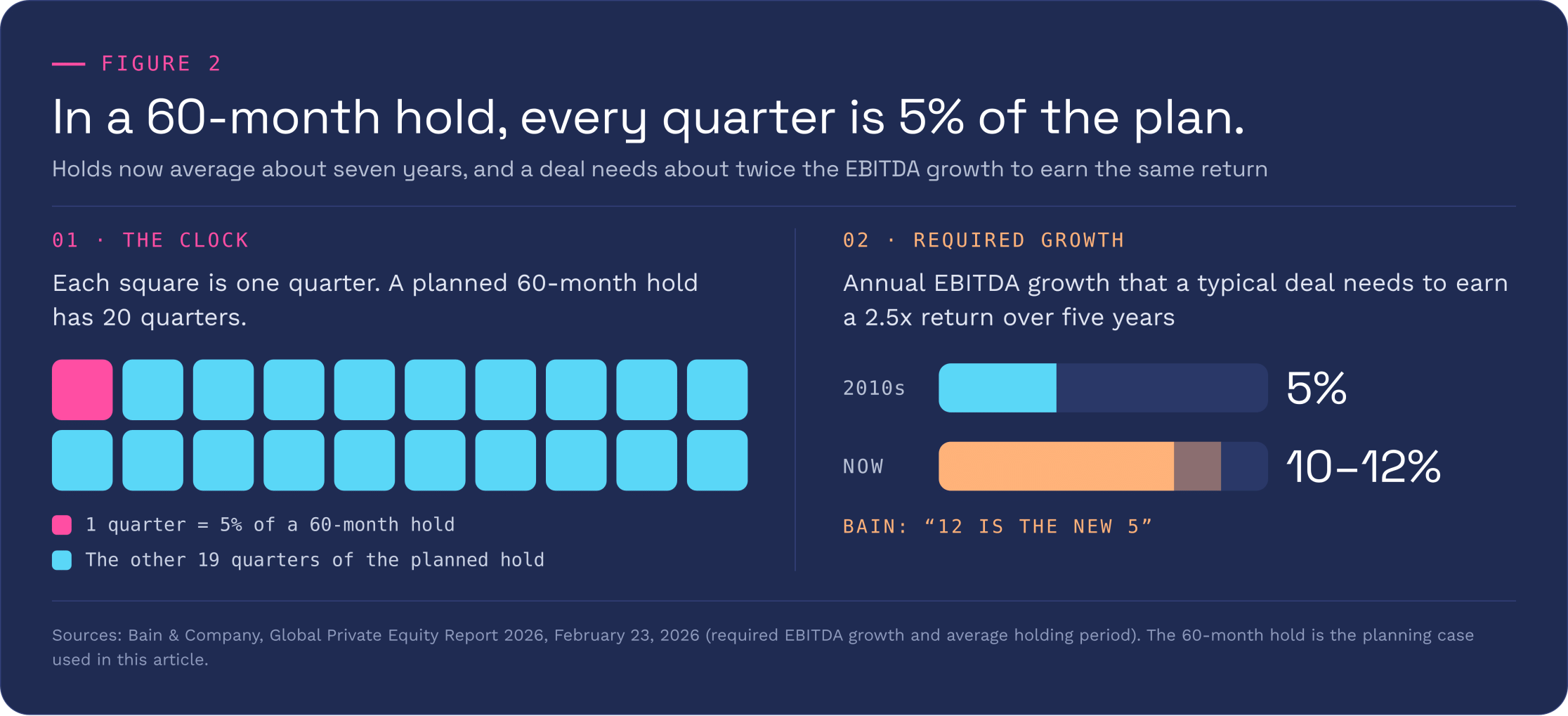
This matters most in a hold. Holds now average seven years,⁶ and sponsors plan on 60 months to grow a company three to ten times on a lean operating model, so every quarter is 5% of the plan.
At Teragonia, our clients reach continuous exit readiness within 100 days, because the foundation is built diligence-ready from the start: it reconciles to the trial balance, traces to each transaction, and stays open to buyer diligence.
The AI services market is getting crowded. In May 2026, OpenAI launched its Deployment Company and Anthropic announced the venture that became Ode. In November, Hg announced a third, with Anthropic participating. Large private equity firms back all three.⁷
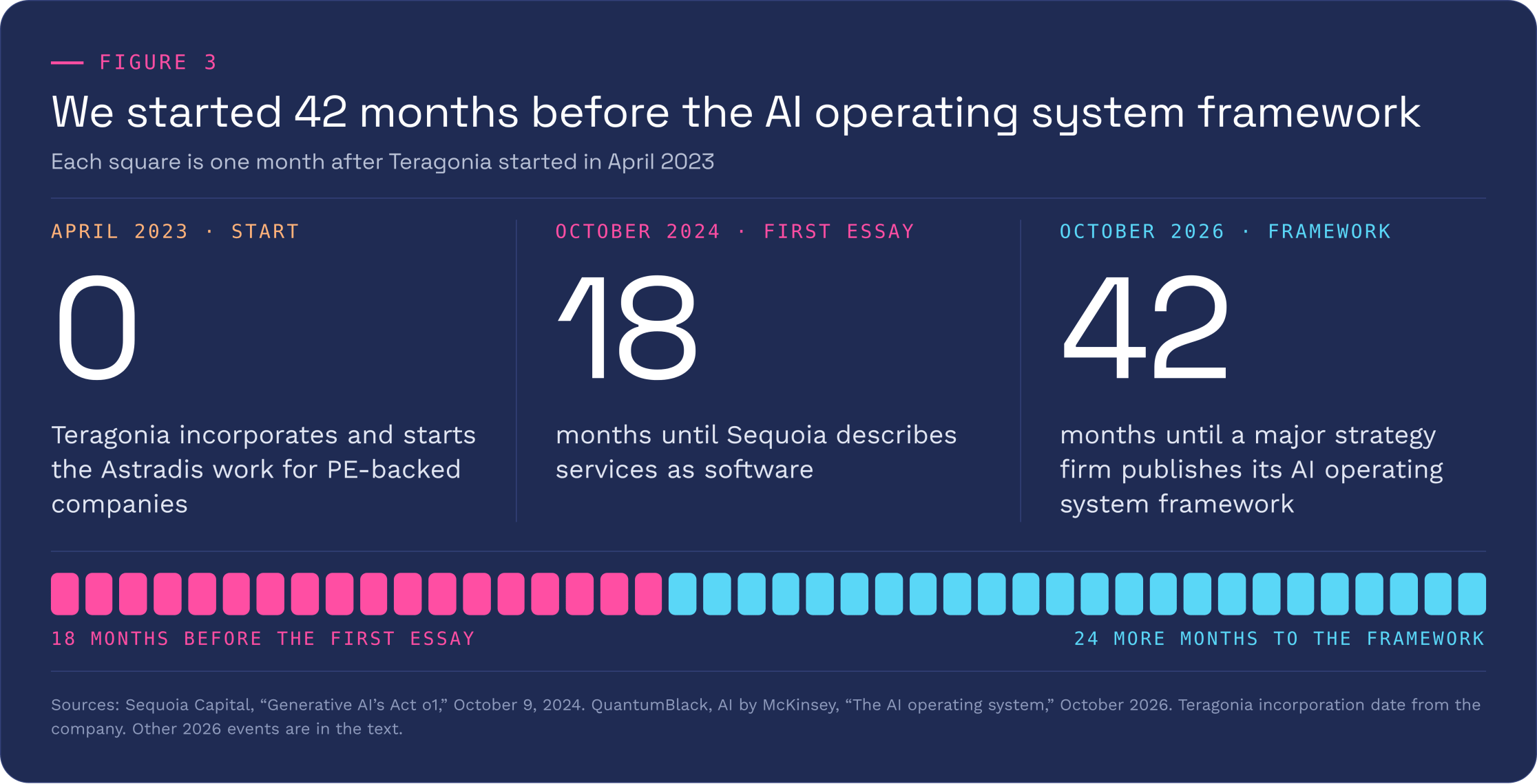
We incorporated Teragonia in April 2023, 18 months before Sequoia described services as software.
In the work we do with clients, we do not bill time and materials.
Fees are fixed or tied to outcomes, milestones run in weeks, and we charge nothing for a key milestone we miss. Outcome pricing only works when measurement is beyond dispute: in one engagement, our foundation reconciled to the client’s trial balance at above 99%, past the client’s own 98% incentive threshold, and Astradis keeps that measurement live and auditable.
The model is agent-first.
Agents act as the consultants; our experts make the final call, own the relationship, lead the change, and act as the pilot in an agentic, autopilot world. Our client delivery portal runs every engagement on standard procedures, while agents do work our team once did manually. Every engagement teaches the agents how our experts frame questions and spot exceptions, so the next body of work moves even faster. The context layer works with any AI model, so each release makes delivery cheaper and leaves the asset untouched.
This is judgment, productized.
Labs deploy their own models well, but a lab earns more as clients use more of its model; we earn when EBITDA moves, on whichever model fits the task, and we test all leading models, monthly. The new ventures are built around forward-deployed engineers. Teragonia is built around an operating system and paid on outcomes. A sponsor will also hesitate to share portfolio data with a vehicle its competitors co-own.
What no one can rent is judgment captured engagement-by-engagement, inside PE-backed companies, on a platform with five patents pending.
The major vacuum manufacturers refused James Dyson’s bagless design in the 1980s because replacement bags were their business. He built the company himself. Billable hours are the consulting industry’s bags: a traditional firm’s P&L, utilization targets, partner pay, and career ladder all rest on the hour.
The large firms’ agents, counted in the tens of thousands, mostly make consultants faster at the same hourly work, and a faster consultant bills fewer hours. To benefit, a firm must change how it charges, delivers, staffs, and builds careers, all at once.
We built Teragonia around all four from the start.
The models I audited early in my career took several minutes to open, and only their authors understood them. Today, a CFO can ask the data a question and get the answer in seconds, in plain English, with the logic, the lineage, and the next step.
I have waited twenty years for this, and three and a half years to bring it to life. The sponsors who start now will carry our head start into their next exit.
About Teragonia
Teragonia turns private equity value creation playbooks into agents that drive the operating rhythm of mid-market businesses within commercial, operations and finance functions. Its team pairs operators who have spent their careers inside private equity, as investors, management teams, and M&A advisors, with AI and ML engineers who have built production systems at Morgan Stanley, GE Research, Barclays, Deloitte, and PwC.

Thomas Thayyil Thomas is CEO and co-founder of Teragonia. He spent more than a decade at Ernst & Young in assurance, M&A due diligence, and strategy consulting in London and Houston. At Houlihan Lokey, he led the Transaction Advisory Services practice in Houston and then built the firm’s global Digital Value Creation practice, which applied AI and machine learning to M&A due diligence and restructuring for major financial sponsors. He has advised financial sponsors, sovereign wealth funds, and Fortune 100 corporations across the M&A life cycle. He is a Chartered Accountant (Institute of Chartered Accountants of Scotland) and holds an MS in International Accounting and Finance from the University of Strathclyde and a Master of Commerce in Finance from Mahatma Gandhi University.
Sources:
J. Ganz and B. Perigaud, dbt Labs, “Semantic Layer vs. Text-to-SQL: 2026 Benchmark Update,” April 7, 2026. Vendor benchmark. https://docs.getdbt.com/blog/semantic-layer-vs-text-to-sql-2026
QuantumBlack, AI by McKinsey, “The AI operating system: A new way for CEOs to run the enterprise,” October 2026. https://www.mckinsey.com/capabilities/quantumblack/our-insights/the-ai-operating-system-a-new-way-for-ceos-to-run-the-enterprise
Sonya Huang and Pat Grady, “Generative AI’s Act o1,” Sequoia Capital, October 9, 2024. https://sequoiacap.com/article/generative-ais-act-o1
Julien Bek, “Services: The New Software,” Sequoia Capital, March 5, 2026. https://sequoiacap.com/article/services-the-new-software/
Jack Moshkovich, “Software Isn’t Dead. What’s Valuable Is Changing.,” 8VC, March 10, 2026. https://8vc.com/resources/software-isnt-dead-whats-valuable-is-changing
Bain & Company, Global Private Equity Report 2026, February 23, 2026. https://www.bain.com/insights/welcome-to-a-new-era-global-private-equity-report-2026/
OpenAI, “OpenAI launches the OpenAI Deployment Company to help businesses build around intelligence,” May 11, 2026. https://openai.com/index/openai-launches-the-deployment-company Business Wire, “Anthropic, Blackstone, and Hellman & Friedman Introduce Ode with Anthropic, an Enterprise AI Services Firm,” July 15, 2026. https://www.businesswire.com/news/home/20260715205134/en/ Hg, “New AI transformation company raises funding to advance AI adoption in Europe,” November 3, 2026. https://www.prnewswire.co.uk/news-releases/new-ai-transformation-company-raises-funding-to-advance-ai-adoption-in-europe-302927628.html
Our core analytics and AI platform drives informed decision-making with enhanced clarity and focus, and rapidly unlocks enterprise value
Core Features:

Integrate data from multiple source systems effortlessly
Critical for breaking down silos and creating a unified view

A secure, centralized cloud hub for all your data insights
Foundational for reliable decision-making and enterprise-wide alignment

Visualize complex data through easy-to-understand dashboards
Empowers leaders with actionable insights

Reverse ETL capabilities enriches your data and ensures your data flows exactly where it is needed for function teams to act on
Enables real-time, action-oriented data flow


BS International Business | American University of Paris
BS Computer Science | American University of Paris
Seasoned DevOps and infrastructure engineer with expertise in AWS, Kubernetes, and Terraform; led cloud migrations and scalable infrastructure projects at Sfara, FanDuel, and Kickstarter.
With over 15 years of experience in small and medium-sized startups, Scott is a seasoned expert in designing, optimizing, and maintaining robust, scalable, and secure infrastructure. He specializes in automation and embedding security from the ground up, consistently delivering reliable systems tailored to meet dynamic business requirements.
Prior to joining Teragonia, Scott made a significant impact at Sfara, where he built the company’s entire infrastructure from scratch. He engineered systems capable of supporting hundreds of thousands of users with seamless scalability, implemented automated development pipelines, and introduced observability tools to monitor and manage resources effectively. Additionally, Scott led the infrastructure team in achieving ISO27001 security certification, ensuring security was integrated into every aspect of the system and transforming it into a critical asset for business-to-business operations.
Beyond his technical expertise, Scott has a proven track record of managing and mentoring high-performing teams. As a Senior DevOps Engineer at FanDuel, he gained invaluable experience in scaling infrastructure and optimizing resources to support millions of daily users, aligning technological capabilities with organizational goals.

Master’s in Human Resources | University of Illinois
Bachelor’s in Management | Loyola University
Former Financial and Operations Manager at Houlihan Lokey, Golin Harris, and MSL Group.
Jack is a highly driven, cross functional professional with extensive experience in operations and administration.
Prior to joining Teragonia, Jack held financial and facilities management roles for Houlihan Lokey, MSL Group/Publicis, and Golin Harris in which managed and created processes and trainings for multiple functional areas ensuring operational and administrative procedures were well planned, efficient, cost-effective, and aligned with business objectives while ensuring initiatives, internal events as well as client events propelled employee and client engagement.
Jack holds undergraduate degrees from University of Illinois and Loyola University Chicago and has completed graduate certificates in Business Administration, Strategic Human Resources, and Operations at Cornell, CUNY-Buffalo, and University of Illinois and is in the process of completing a Master’s in Human Resources at Loyola University Chicago’s Quinlan School of Business.

MS Analytics | Georgia Institute of Technology
BS Management Information Systems | Oklahoma State University
Former analytics engineer at Cyderes and ConocoPhillips with a Master’s in Analytics from Georgia Institute of Technology and a Bachelor’s in Management Information Systems from Oklahoma State University
Mason is an Analytics Engineer with deep experience in data analytics, business intelligence, machine learning, and cybersecurity. He brings a proven track record of leading analytics engagements spanning architecture, insights, visualizations, and delivery.
Before joining Teragonia, Mason was a Senior Analytics Engineer at Cybersecurity MSSP CYDERES where he built a scalable, standardized, and secure analytics architecture for over 300 clients across many industries and consulted with them to deliver insights through bespoke data driven solutions. In addition, he managed the data delivery of the insight platform leveraged by the Security Operations Center to respond to incidents in a timely and effective manner.
Prior to joining CYDERES, Mason worked in ConocoPhillips’ Analytics and Innovation Center of Excellence holding varied roles within the Data Analytics organization from Data Engineering, to Business Intelligence, and Data Science. He delivered robust data solutions in all operating units for various functions including Engineering and Production, Finance, IT, and more. Including projects to standardize cost and production data across operating units.
Mason started his career at The Williams Companies in cybersecurity and transitioned to cybersecurity at ConocoPhillips where he found his passion for Data Analytics through SIEM management, detection engineering, and threat intelligence.

Bachelor’s in Finance & Accounting | Georgetown University
Former analytics engineer at Houlihan Lokey and financial analytics at JP Morgan Chase with a Bachelor’s in Finance & Accounting at Georgetown University
Grace is a seasoned analytics engineer with specialized expertise in crafting and implementing analytics solutions that drive agile, informed executive decisions in M&A and value creation for private equity-backed companies.
Before joining Teragonia, Grace was a part of the data science and business analytics team at Houlihan Lokey. She has excelled in harmonizing, enriching, and analyzing data from diverse sources, providing key insights that enabled private equity investors and portfolio company executives to make rapid, data-driven decisions across the investment lifecycle. She has developed novel analytics solutions, including deal sourcing and evaluation tools for platform investments that employ a buy-and-build or de novo growth strategy, as well as post-close value creation and KPI reporting tools for operators and management teams.
Grace has also worked at JPMorgan Chase & Co. in the Global Finance and Business Management rotational program, where she built analytics solutions to evaluate banker attrition and KPI reporting within the Global Private Bank.